
Single Mode Fiber vs Multimode Fiber: Choosing the Right Fiber Optic Cable for Your Project
Summary: Choosing between single-mode fiber and multimode fiber is a critical decision in modern network design. Each option differs in core size, distance capability, and cost structure. This guide explains the key differences, helping installers and engineers select the right fiber optic cable type for reliable performance and long-term scalability.
In modern network infrastructure, the discussion around single mode fiber vs multimode fiber is not just technical—it is foundational. The fiber you choose determines how far your data can travel, how stable the signal remains, and how well your network handles future demand. Across different fiber optic cable types, this decision directly impacts performance, especially when comparing a single mode fiber optic cable with a multimode fiber optic cable in real-world deployments. As systems expand across buildings, campuses, and cities, installers and engineers must clearly understand the trade-offs involved in single mode vs multimode fiber cost and long-term scalability before deployment begins.
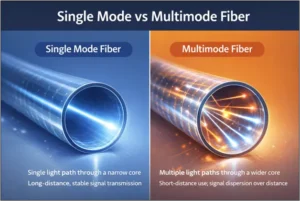
Difference Between Single Mode and Multimode Fiber
At a practical level, the difference between single mode and multimode fiber comes down to how light behaves once it enters the cable. In multimode setups, multiple light paths travel simultaneously, which works efficiently in controlled environments but introduces dispersion over distance. This is where the performance gap in single mode fiber vs multimode fiber becomes noticeable.
In contrast, a single-path transmission keeps signals more stable and predictable. When comparing a single mode fiber optic cable to a multimode fiber optic cable, this difference directly affects signal clarity, especially over longer runs. Understanding this distinction helps installers avoid performance issues that often arise when the wrong fiber type is used for the application.
Single Mode Fiber Optic Cable
As network requirements extend beyond confined environments, the need for this fiber optic cable type becomes more apparent. It is designed to maintain signal integrity across significantly longer distances, making it essential for backbone infrastructure applications.
In practical applications, this becomes the preferred choice when comparing multimode fiber vs single- mode distance capabilities. Installations that span campuses or connect multiple facilities rely on single-mode performance to avoid signal degradation. While the single-mode vs multimode fiber cost may appear higher initially, its ability to support long-term scalability often justifies the investment.
MultiMode Fiber Optic Cable
In most day-to-day installations, this option is widely used for short-range connectivity. It fits naturally into structured cabling systems where distances are limited, and performance requirements are clearly defined. It is commonly chosen among different fiber optic cable types for its ease of installation and compatibility with cost-effective hardware.
Within buildings and data centers, multimode fiber supports consistent performance without overengineering the system. When evaluating single mode fiber vs multimode fiber, this is where multimode holds its ground – delivering reliable throughput for localized networks while keeping the single-mode vs multimode fiber cost consideration in check for shorter runs.
Multimode Fiber vs Single Mode Distance
Distance is where most decisions become clear. The comparison of multimode fiber vs single mode distance highlights the physical limitations of each option. Multimode fiber performs reliably within a few hundred meters, which aligns with most indoor applications using a multimodal fiber optic cable.
However, as soon as those limits are exceeded, performance begins to decline. This is where a single mode fiber optic cable becomes necessary, offering consistent transmission over several kilometers. When evaluating single mode fiber vs multimode fiber in real-world layouts, distance is often the factor that eliminates uncertainty and drives the final decision.
If you are planning extended cable runs and need clarity, you can ask an expert at Remee for project-specific guidance.
Single Mode vs Multimode Fiber Cost
The single-mode vs multimode fiber cost comparison requires a broader perspective than just cable pricing. While a single mode fiber optic cable may have a lower material cost, the associated components increase the initial investment. On the other hand, a multimode fiber optic cable offers a more budget-friendly setup for short-range applications.
In real-world scenarios, cost decisions often tie back to application scope. For shorter networks, multimode keeps costs controlled, but for larger systems, the limitations highlighted in multimode fiber vs single-mode distance can lead to additional expenses later. This is why many projects evaluate single mode fiber vs multimode fiber, not just on upfront cost but on long-term performance and upgrade requirements.
For projects requiring tailored solutions for fiber optic cable types, you can request a new custom cable from Remee.
Fiber Optic Cable Types
Across various fiber optic cable types, selecting the right option depends entirely on application requirements. Whether choosing a multi mode fiber optic cable for short-range efficiency or a single mode fiber optic cable for long-distance performance, the decision must align with system demands.
Understanding how these options compare in terms of single mode fiber vs multimode fiber, including performance and single-mode vs multimode fiber cost, helps ensure the network is neither overbuilt nor underperforming. In practice, the right choice is always the one that fits the environment, not just the specification sheet or price.
The Remee Approach to Fiber Solutions
At Remee, fiber solutions are developed with real-world applications in mind. From selecting the right fiber optic cable types to supporting both single mode fiber optic cable and multimode fiber optic cable deployments, the focus remains on performance and reliability.
This includes:
- Standards-compliant designs
- Indoor and outdoor configurations
- Custom engineering capabilities
- Consistent manufacturing quality
Each solution is built to align with actual installation conditions, ensuring that performance expectations are met in the field.
Making the Right Fiber Decision
The choice between single-mode fiber and multimode fiber ultimately depends on how your network is expected to perform over time. Comparing options such as a single mode fiber optic cable and a multimode fiber optic cable highlights the trade-offs between distance, cost, and scalability.
Short-range systems benefit from the efficiency of multimode cable solutions, while long-distance networks rely on single-mode cable performance. By understanding the difference between single-mode and multimode fiber, along with factors like multimode fiber vs single-mode distance and single-mode vs multimode fiber cost, you can make a decision that supports both current needs and future growth.
FAQ:
Q1: How do I decide between single-mode and multimode fiber for my specific project?
A: The decision usually comes down to distance and future scalability. For short, contained environments like offices or data centers, multimode is often sufficient and cost-effective. However, if your network spans multiple buildings or may expand over time, single-mode is typically the better choice due to its ability to maintain performance over long distances, including as a backbone to the infrastructure.
Q2: Can I upgrade from multimode fiber to single-mode later without replacing the entire cable?
A: In most cases, multimode and single mode fiber optic cables have different core sizes and require different optical components. Upgrading usually involves replacing the existing cable infrastructure, which is why planning for long-term and future requirements at the beginning is critical.
Q3: Does single-mode fiber always perform better than multimode fiber?
A: Not necessarily. While single-mode fiber offers better performance over long distances, multimode fiber performs very efficiently in short-range applications. In controlled environments, multimode can deliver high speeds at a lower overall cost, making it the more practical choice for many installations.
Q4: Are there specific environments where one fiber type is preferred over the other?
A: Yes. Multimode fiber is commonly used in indoor environments such as data centers and office networks where distances are limited. Single-mode fiber is preferred for outdoor runs, campus networks, and industrial applications where longer distances and higher reliability are required.