Digital Electricity and Fault Managed Power Systems: The Future of Safe Power Distribution
Summary: Digital Electricity™ and Class 4 fault managed power systems are redefining how designers safely deliver higher power over longer distances. With the introduction of Article 726 in the 2023 NEC, Class 4 circuits now recognize line‑powering technologies that use continuous fault monitoring to provide “touch‑safe” high‑energy distribution. Remee’s Activate PowerPipe cables support these systems by combining pulse power transmission, long‑reach capability, and robust code compliance for smart buildings, transportation, campuses, and critical infrastructure.
How do you deliver up to hundreds of volts across hundreds of meters and still keep people as safe as if they were touching low‑voltage cabling? Class 4 FMPS, formalized in the 2023 NEC Article 726, answers this challenge by constantly monitoring circuits and shutting down power within milliseconds when a fault is detected.
Instead of relying only on traditional overcurrent devices, these systems use intelligent transmitters and receivers to sense conditions such as shorts, improper wiring, or human contact, cutting power before harm or equipment damage occurs.
Fault Managed Power Systems: A New Model for Safe Power Delivery
Fault Managed Power Systems (FMPS) use digital monitoring to sense unsafe conditions and shut down power within fractions of a second. Instead of depending only on thick copper or heavy conduit, FMPS uses logic-based protection to create a safer, high-power pathway.
What makes FMPS different?
- Continuous digital monitoring
- Instant power shut-off during a fault
- Support for long-distance power transmission
- Safer than traditional low-voltage power under fault conditions
- Approved as Class 4 under NEC Article 726
These systems allow integrators to plan for growth without adding large conduits, vaults, or multiple power supplies across long runs.
Curious about integrating PowerPipe™ and FMPS into your next project? Ask an Expert at Remee for tailored recommendations.
Why Fault Managed Power Systems Are Outpacing Legacy Approaches
Class 4 FMPS bridges the gap between conventional low‑voltage and AC distribution by offering higher wattage, longer distances, and enhanced safety in a single architecture.
Key advantages include:
- Higher power capacity than typical limited‑energy circuits, enabling support for demanding loads such as transportation systems, DAS, lighting, and industrial devices.
- Continuous line monitoring delivers automatic fault isolation instead of relying solely on fuses or breakers that respond only to overcurrent conditions.
- DC distribution that aligns well with modern electronics, smart buildings, and distributed IoT infrastructure, minimizing conversion losses.
Because Class 4 systems are designed as line‑powering solutions, they can displace or supplement many PoE and AC applications, simplifying infrastructure in large buildings, campuses, transportation hubs, and mission-critical facilities.
Overcoming Power over Ethernet Limitations with PowerPipe™ Pulse Power
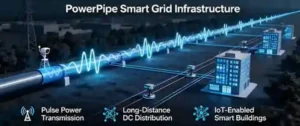
Standard Power over Ethernet technologies are typically limited to 100 meters from switch to device, constrained primarily by the data signal rather than power alone. Even with higher‑power PoE variants, designers often require mid‑span injectors, extra electronics, or new AC runs to reach remote devices.
Remee’s Activate™ cables address these Power over Ethernet limitations by combining copper multipair and hybrid copper/fiber designs, enabling delivery of nearly 20 times the power of PoE over hundreds of meters while using low‑voltage installation practices. This is achieved through pulse power transmission, sometimes referred to as Digital Electricity™ or packet energy transfer, which sends energy in monitored pulses along line‑powered Class 4 circuits.
Need a custom solution for your high-power, long-distance application? Request a New Custom Cable from Remee to meet unique specs.
Compliance and Design Considerations for Class 4 Systems
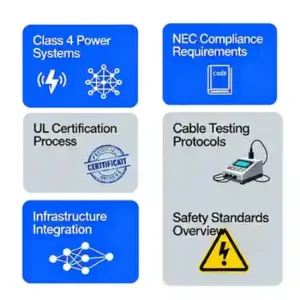
Because Class 4 is now defined in Article 726, designers and integrators must carefully select cabling, terminations, and installation methods that align with the NEC and relevant UL standards. PowerPipe™ Class 4 cables are UL 1400‑2 certified and listed for plenum, riser, general purpose, and direct‑burial environments, greatly reducing code‑compliance guesswork.
Dual‑listed CL4Z/CL4P options allow a single cable type to pass through mixed plenum, riser, and outdoor runs without transitioning between different constructions, simplifying inspections and inventory management.
Digital Electricity™ and Class 4 fault managed power systems are redefining what is possible in safe, long‑distance power delivery, and Activate™ cables are at the center of this shift by combining high-power capability, long-reach capability, and robust compliance in one family of solutions.
If your next smart building, campus, or transportation project needs higher power, longer distances, and uncompromising safety, Ask an Remee Expert about Class 4 design options.
Note: Digital Electricity is a trademark of VoltServer, Inc.
FAQ:
Q1: How do Class 4 fault managed power systems differ from traditional low‑voltage circuits?
A: Class 4 systems operate at significantly higher voltages and power levels than typical Class 2 and 3 limited‑power circuits, yet maintain a comparable safety profile by using real‑time fault detection and automatic shutdown. Traditional low‑voltage systems largely rely on static limits and basic overcurrent protection, whereas Class 4 actively monitors line conditions and can isolate faults within milliseconds, even for issues that do not manifest as simple overloads.
Q2: What makes PowerPipe™ cables the best for Class 4 installs?
A: These cables are engineered and tested for fault-managed high-voltage DC use. They feature copper or multipair/fiber hybrid designs and comply fully with new NEC and UL standards, making installations safer, easier, and code-compliant.
Q3: How do Class 4 systems benefit smart buildings and campuses?
A: They deliver higher power over greater distances, simplify compliance, and enable future-ready IoT and automation, making infrastructure more scalable and cost-effective.
Q4: Can PowerPipe™ cables handle both data and high-power needs?
A: Yes. Their hybrid design supports simultaneous power and fiber-optic transmission, reducing the need for separate runs. Additionally, their dual-listed copper PowerPipe™ cables allow a single cable type to pass through mixed plenum, riser, and outdoor runs without transitioning between different cable constructions.