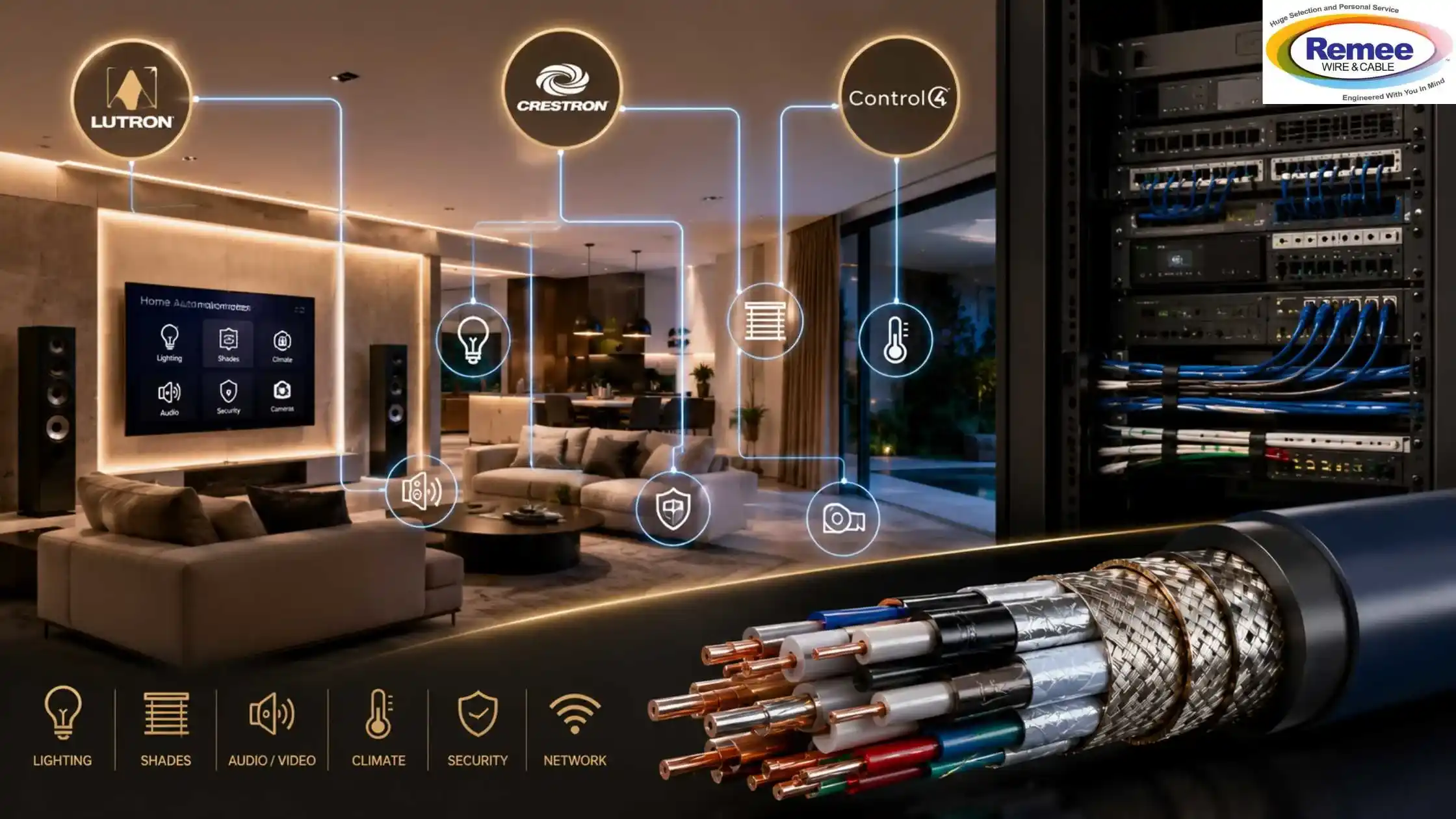
System Integration: Cable Requirements for Popular Home Automation Systems
A smart home may look wireless on the surface, but behind the walls, most large-scale automation projects still depend on structured cabling to do the heavy lifting. Lighting scenes, motorised shades, climate control, distributed audio, surveillance, touch panels – none of these work reliably without solid infrastructure underneath. And this is usually where projects start separating into two categories: systems that feel seamless for years, and systems that slowly turn into service calls. Because every major Home Automation System handles communication differently.
Lutron, Crestron, Control4, Elan, and Vantage systems may all power and control smart home devices, but behind the walls, this works very differently. Each platform has its own cabling needs, control structure, and communication methods.
A setup that works perfectly for one system may create problems for another, once lighting, audio, security, and networking all start sharing the same infrastructure.
And most problems do not appear immediately. This usually shows up later – after the walls are closed, pathways become crowded, or the homeowner suddenly wants more devices added. That is why good automation infrastructure matters early on. A well-designed Home Automation System is not just easier to install. It remains reliable, expandable, and easier to service long after installation is complete.
Why Cabling Still Matters in Modern Automation Systems
Modern smart homes create the impression that everything runs wirelessly.
In reality, large-scale Home Automation System deployments still rely heavily on structured low-voltage cabling behind the scenes. Once projects move beyond a few smart switches and app-controlled devices, wireless-only environments start creating problems surprisingly fast.
Installers usually see the same patterns:
- Delayed device communication
- Wireless congestion
- Inconsistent subsystem response
- Retrofit limitations
- Signal reliability issues between rooms
And the larger the project becomes, the more obvious those issues are.
This becomes especially noticeable inside integrated control systems, where lighting, HVAC, AV distribution, security, shading, and access control all need to communicate consistently across the same automation infrastructure.
Luxury residential projects expose weak cabling design quickly because expectations are extremely high. Homeowners may tolerate buffering on Netflix. They usually do not tolerate lighting scenes failing during dinner parties.
Why Home Automation Systems Have Different Cable Requirements
Not every automation platform communicates the same way.
That is why experienced integrators start planning cable layouts long before equipment arrives on-site.
A Lutron HomeWorks QS deployment, for example, may require dedicated low-voltage control wiring between processors, lighting panels, keypads, and shading systems. Crestron environments often involve larger centralized control architectures with extensive network infrastructure and equipment rack integration.
Control4 typically relies heavily on structured Ethernet distribution alongside AV and control cabling throughout the property. And so on with other automation system providers.
On a floor plan, these systems can look almost identical.
Inside the rack room, this becomes very different very quickly.
Each Home Automation System introduces its own requirements around:
- Power distribution
- Communication protocols
- Shielding needs
- Cable distance limitations
- Signal isolation
- Centralised versus distributed architecture
And once drywall is complete, fixing poor cable planning becomes expensive fast.
That is why professional automation system integration starts with infrastructure design first – not device selection.
Planning a multi-platform smart home project?
Small cabling decisions – and the right guidance early – can prevent major limitations later.
The Real Challenge with Automation System Integration
Connecting one smart device is easy.
Building dozens of subsystems that continue working together reliably for years is where things become complicated.
A modern Home Automation System may include:
- Lighting control
- Motorised shading
- Multi-room audio
- Climate automation
- Security integration
- Surveillance systems
- Access control
- Distributed AV
Every added subsystem increases the complexity of the automation system integration.
Eventually, all those cables start sharing the same conduit paths, equipment racks, enclosures, and low-voltage pathways. Cable density increases quickly, especially in luxury homes and mixed-use properties.
And this is usually the stage where installers begin appreciating composite cable designs.
Not because the brochure looks impressive.
Because pulling six separate cable types through one crowded pathway becomes difficult very quickly.
Automation projects scale much more smoothly when the infrastructure is built for future expansion.
Why Composite Cables Simplify Installation
Large automation projects can become cable management nightmares surprisingly fast.
Touch panels, speakers, sensors, control wiring, AV distribution, network infrastructure, shading systems – every subsystem introduces another layer of cabling inside the automation infrastructure.
Composite cable designs simplify that process by combining multiple cables, each with its own function, into one overall jacket.
Depending on the application, a composite cable may combine:
- Category cable
- Shielded pairs
- Audio conductors
- Control wiring
- Power conductors
- Coaxial cabling
- Access control and security cables
That creates several practical advantages on-site:
- Faster installation
- Cleaner pathways
- Less conduit congestion
- Easier rack organisation
- Simplified servicing later
- Better long-term cable management
Remee’s automation and multimedia cable portfolio includes hybrid and bundled cable constructions specifically designed for automation system integration involving Lutron, Crestron, Control4, Elan, Vantage, and other system environments.
Experienced installers understand something product brochures rarely mention clearly:
A clean rack today usually means fewer troubleshooting calls later.
Why Shielding and Cable Construction Matter More Than People Expect
Modern integrated control systems operate inside electrically noisy environments.
Automation cabling often shares pathways with:
- HVAC equipment
- Lighting systems
- Electrical infrastructure
- Motorised shading systems
- Network switches
- AV distribution equipment
Without proper shielding or cable separation, interference issues slowly begin surfacing over time.
Usually in frustrating ways:
- Delayed keypad response
- Random subsystem disconnects
- Intermittent control failures
- Unstable automation behaviour
- Noise inside audio systems
And diagnosing those problems after installation is rarely simple.
That is why professional installers pay close attention to:
- Shielded vs unshielded construction
- Plenum and riser ratings
- Conductor quality
- Jacket flexibility
- Environmental durability
- Long-term signal stability
A strong automation infrastructure is not simply about making the system function during commissioning.
It is about keeping everything stable years later, when the homeowner adds more devices that the integrator originally warned them about.
Structured Cabling Still Sits at the Core of Integrated Control Systems
At its core, every large Home Automation System is really a communication network disguised as convenience.
Everything depends on stable signal transmission within the infrastructure.
That is why structured cabling continues to matter heavily across modern integrated control systems supporting:
- Whole-home audio
- Smart lighting
- Voice control
- Security platforms
- Energy management
- Occupancy sensing
- Climate automation
As bandwidth demands increase, weak infrastructure becomes visible quickly.
Most professional installers now design automation infrastructure with future upgrades already in mind because expansion requests almost always happen later.
Usually, right after the paint dries.
Future upgrades always sound simple until there is no pathway space left.
Why Experienced Installers Plan for Expansion Early
One of the most common automation mistakes is designing only for current requirements.
Because Home Automation System projects rarely are finished.
Clients add:
- More lighting zones
- Outdoor entertainment areas
- Additional displays
- Expanded audio coverage
- Extra surveillance cameras
- More advanced control scenes
Sometimes, only weeks after move-in.
That is why experienced integrators leave extra conduit space, pathway capacity, and future cable access during the original installation.
The ability to expand later matters just as much as getting the system operational today.
And honestly, that mindset separates long-term infrastructure planning from basic device installation.
Good automation starts long before programming begins.
The long-term reliability of a Home Automation System often depends more on the underlying automation infrastructure than the devices homeowners interact with every day.
Lutron, Crestron, et al., introduce different communication methods, control strategies, and cable requirements. That is why successful automation system integration is rarely about adding more technology. It is usually about building cleaner, more organised infrastructure underneath it.
Composite cable designs, structured cabling, proper shielding, and scalable pathway planning all play a major role in keeping integrated control systems stable long after installation is complete.
Homeowners usually only notice the system when something stops working.
More often than not, those failures trace back to infrastructure decisions made years earlier.
Frequently Asked Questions
Q1: Why do Lutron, Crestron, Control4, et al. require different cable types?
Each platform uses different communication protocols, control architecture, power distribution methods, and subsystem integration requirements. That is why every Home Automation System may require different cable constructions depending on the application.
Q2: What is automation system integration?
Automation system integration refers to connecting multiple smart subsystems – including lighting, HVAC, AV, security, shading, and climate control – into one unified operating environment.
Q3: Why are composite cables useful in automation projects?
Composite cables simplify automation system integration by combining multiple cable, each with its own different function, into one outer jacket, helping reduce conduit congestion and improve overall cable management.
Q4: Why does shielding matter in integrated control systems?
Proper shielding helps reduce electromagnetic interference created by electrical systems, HVAC equipment, lighting controls, and nearby power infrastructures that can affect signal stability inside integrated control systems.
Q5: Why is structured cabling still important in modern smart homes?
Structured cabling provides the stable automation infrastructure required for long-term performance, scalability, and reliable communication across large Home Automation System deployments.