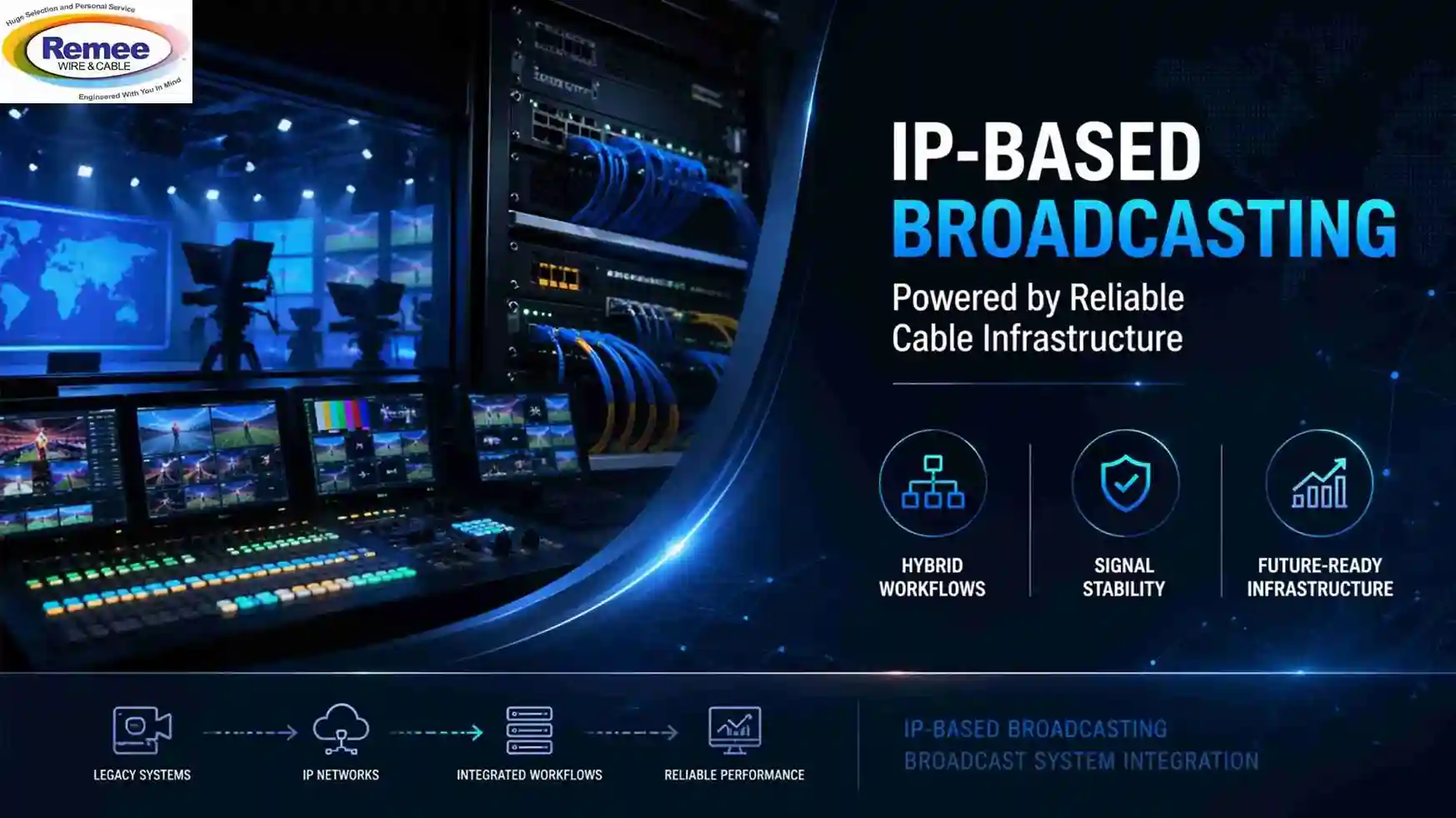
How Cable Infrastructure Powers IP-Based Broadcasting Workflows
Summary: As IP-based broadcasting becomes the foundation of the design and growth of production facilities, existing workflows continue to adopt greater flexibility and usage of data, while cable infrastructure continues to be critical for performance and reliability. This post will look at how broadcast system integration works in real-world conditions, why hybrid systems are common, and what it takes to ensure reliable system stability for the long term.
IP-based broadcasting often gets characterized as a move from entirely legacy systems to a fully network-dependent system. The reality of today’s broadcast environment, however, relies heavily on hybrid systems where both modern technology and legacy infrastructure share space and coexist within a production environment.
It is these environments that make cable infrastructure so essential. The cable will no longer simply carry fixed signals; it will carry data across systems and be a vital part of a successful broadcast system integration.
Why IP-Based Broadcasting Is Changing System Design
IP-based broadcasting enables new, more flexible system architectures than are possible in the traditional world, allowing for rapid system resizing and workflow reconfiguration. The increased demand on the cable infrastructure means systems must now transmit data across a shared network in continuous, high-volume packets. This environment demands more from your physical layer, as even a small fault at this level can cripple your system.

Why Cable Infrastructure Still Defines Performance
System performance in any broadcast environment depends on the strength of your infrastructure, whether legacy or IP-based. Many of the systems’ failings can often be found at the physical layer, whether it be interference, latency, or overall instability. While it may appear as a supporting element, the cable infrastructure will provide the stable and reliable data stream necessary for a functioning IP-based broadcast system, especially as resolutions increase and more timing-precise data needs to be transmitted.
Broadcast System Integration in Real Installations
Broadcast system integration is where theory becomes practice. While purely IP-based broadcasting is still a long way off for many installations, most are running a hybrid system. Effectiveness is then a delicate balancing act to ensure all parts of the system run together smoothly:
- Merging traditional with new IP systems
- Providing compatibility between disparate systems and signal formats
- Maintaining the same level of consistency across broadcast channels
- Ability to support multiple different signal formats at once
Each of these considerations requires a well-designed and functioning cable infrastructure upon which they all rely.
Hybrid Workflows and the Role of Physical Connectivity
Pure IP-based broadcasting has not quite materialized for most organizations, hence the rise of the hybrid system. These systems allow for an easier and less disruptive transition from current technologies. Cable infrastructure in hybrid systems must provide support for both dedicated signal paths and high-volume data streams concurrently. A stable and consistent flow is paramount.
Installation Challenges: Bandwidth, Interference, and Scale
As the broadcast systems grow and expand, installation becomes a more involved process. High-definition demands are greater, thus requiring more bandwidth, and as density increases, so does potential interference. Commonly encountered installation hurdles are:
- Maximizing cable density in small areas
- Minimizing interference from neighboring electrical sources
- Maintaining signal integrity over large distances
- Adapting systems to current, often non-ideal, conditions
Hybrid Workflows and the Role of Physical Connectivity
Technology will continue to evolve, meaning the future of broadcasting will demand higher resolutions and higher bandwidth streams. To be future-ready, organizations must consider investments that can scale with the increasing demands placed upon the system, offering flexibility, high bandwidth, and reliability over the long term.

Supporting Modern Workflows with Reliable Solutions
Modern systems utilize both new and old technologies to ensure they can meet any broadcast need. A stable infrastructure that ensures reliable communication between all components provides the ideal foundation for either system. For successful broadcast system integration, especially with hybrid workflows, an infrastructure that enables robust communication throughout the system is essential.
Building the Foundation for Next-Gen Broadcast Systems
IP-based broadcasting is revolutionizing the broadcast landscape, but it does not diminish the value of cable infrastructure. Instead, it heightens it as it becomes the most important aspect in providing a reliable system. As more hybrid systems are designed and deployed, the infrastructure they are built upon will ultimately dictate how easily the system scales and the quality of the broadcast systems themselves.
For those planning for any future broadcast system integration with hybrid environments in mind, a proper evaluation of current infrastructure will be key.
Should your current or future projects fall under these categories, ask an expert at Remee to help guide you.
FAQ
Q1: What are the main differences between traditional broadcast systems and IP-based broadcasting?
A: IP-based broadcasting transmits signals across a network, rather than over dedicated channels, which enhances flexibility but increases the importance of having robust cable infrastructure.
Q2: How is cable infrastructure still relevant to modern broadcast systems?
A: Signals require physical paths to travel. Cable infrastructure ensures stable signal transfer, minimizes interference, and guarantees consistent system performance.
Q3: What are common challenges encountered during broadcast system integration?
A: Issues often arise when combining legacy broadcast systems with modern IP-based broadcasting systems, creating a complex network environment that needs stable infrastructure.
Q4: Why is the hybrid system commonly used in broadcast installations?
A: Hybrid systems are often utilized to phase in new IP-based broadcasting technology without completely replacing existing infrastructure, offering a more gradual migration for organizations.
Q5: How can an installation be better prepared for future broadcast system needs?
A: Investing in high-bandwidth, scalable cable infrastructure allows broadcast systems to grow in response to future demands, thereby simplifying broadcast system integration for upcoming projects.