Cat5e vs Cat6 vs Cat6A: Making the Right Choice for Enterprise Networks Today
Summary: Choosing between Cat5e vs Cat6 vs Cat6A is a pivotal decision for any modern enterprise. This guide explores the critical differences in bandwidth, transmission speeds, and distance limitations to help you optimize your structured LAN cabling. Learn how Remee’s STREAMline™ portfolio provides high-performance Ethernet cable solutions that balance budget constraints with the need for scalable, future-proof network cabling capable of supporting up to 10 Gigabit Ethernet speeds.
In an era where data is the lifeblood of business operations, the physical infrastructure supporting that data is more critical than ever. As enterprises migrate to the cloud, adopt Wi-Fi 6/6E, and integrate high-definition surveillance, the demand for bandwidth is skyrocketing. Many IT managers face a common dilemma: is it time to upgrade to the latest standards, or does the existing infrastructure suffice?
The choice between cat5e vs cat6 vs cat6a isn’t just about speed; it’s about reliability, crosstalk mitigation, and future-proofing your investment. A mistake in selecting your category cable today can lead to costly retrofits and network bottlenecks tomorrow.
Breaking Down the Specs: Cat5e vs Cat6 vs Cat6A
Understanding the technical nuances of each category of cable type is the first step toward a successful network design. Let’s examine the hierarchy of performance.
1. Cat5e: The Legacy Standard for Gigabit Ethernet Cable
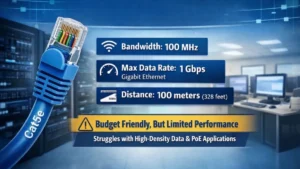
Category 5e (Enhanced) was for years the “gold standard” for general office environments.
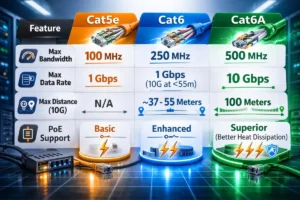
- Bandwidth: 100 MHz
- Max Data Rate: 1 Gbps (Gigabit Ethernet)
- Distance: 100 meters (328 feet)
While Cat5e is budget-friendly, its limited bandwidth means it struggles with high-density data environments and modern Power over Ethernet (PoE) applications.
2. Cat6: The Sweet Spot for High-Performance Ethernet Cable
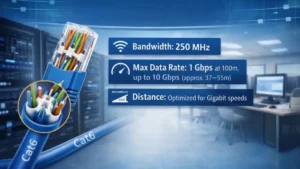
Cat6 was designed to reduce “crosstalk”—the interference between the conductors inside the cable. It often features a physical separator called a “spline” to keep pairs apart.
- Bandwidth: 250 MHz
- Max Data Rate: 1 Gbps at 100m; up to 10 Gbps at shorter distances (approx. 37–55m).
- Distance: Optimized for Gigabit speeds at full length.
3. Cat6A: The 10 Gigabit Ethernet Cable for Future-Proofing
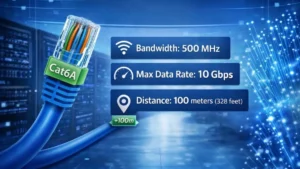
Cat6A (Augmented) doubles the bandwidth of Cat6 and is designed specifically to support 10GBASE-T over the full 100-meter channel.
- Bandwidth: 500 MHz
- Max Data Rate: 10 Gbps
- Distance: 100 meters (328 feet)
Comparing Performance and Distance Limitations
When planning structured LAN cabling, distance is the primary constraint. While Cat6 can technically hit 10 Gbps speeds, it can only do so in short runs. In an enterprise environment where cable paths are often long and complex, relying on Cat6 for 10G performance is risky. Cat6A eliminates this uncertainty, providing consistent 10 Gbps performance regardless of the layout.
Strategizing Your Network Upgrade
Upgrading your infrastructure requires more than just buying the fastest cable available. You must weigh the “cost per port” against the “cost of obsolescence.”
If your facility is planning to implement high-power PoE (Type 3 or Type 4) for smart lighting or advanced security cameras, Cat6A is the logical choice due to its better heat dissipation. However, for standard VoIP and general internet usage in smaller offices, Cat6 remains a cost-effective workhorse.
If you are unsure which path aligns with your specific facility requirements, our team is here to help. You can easily ask an expert at Remee to receive personalized technical guidance on your upcoming project.
Scaling with Remee’s STREAMline™ Structured Cabling Solutions
At Remee Wire & Cable, we understand that every enterprise has unique demands. Our STREAMline™ multi-category portfolio is designed to provide maximum flexibility. Whether you need unshielded (UTP) or shielded (F/UTP) options, our cables are engineered to meet and exceed TIA/EIA standards.
By choosing Remee, you aren’t just buying network cabling; you are investing in a high-performance ecosystem. Our STREAMline™ products offer:
- Scalability: Move from 1G to 10G seamlessly.
- Reliability: Strict quality control ensures low signal loss.
- Customization: If off-the-shelf solutions don’t fit, we can build it for you.
For projects with highly specific architectural or environmental needs, you can request a new custom cable from Remee to ensure your infrastructure is perfectly tailored to your goals.
The battle of cat5e vs cat6 vs cat6a ultimately comes down to your long-term vision. If you are building for the next decade, Cat6A is the only choice that ensures your structured LAN cabling won’t need to be ripped out when 10 Gbps becomes the desktop standard.
Remee’s STREAMline™ portfolio bridges the gap between today’s budget and tomorrow’s performance. By selecting the right category cable now, you protect your enterprise from downtime and ensure a robust foundation for all your digital initiatives.
The line of Activate™ Powered Cable Solutions offered by Remee provides an alternative to category cabling if longer distances and powered pairs are required.
Ready to start your next project? Contact Remee today for a detailed quote or more information on our high-performance Ethernet cable options. Let’s build a faster, more reliable future together.
FAQ:
Q1: Is Cat6A backward compatible with Cat5e and Cat6?
A: Yes, Cat6A is fully backward compatible. You can use Cat6A patch cords with Cat6 or Cat5e jacks, though the network will only perform at the level of the lowest-rated component in the link.
Q2: When should I choose shielded (F/UTP) over unshielded (UTP)?
A: Shielded cables are essential in environments with high electromagnetic interference (EMI), such as manufacturing floors or data centers with dense cabling. For most standard office environments, UTP is sufficient.
Q3: Why is bandwidth (MHz) important if the speed (Gbps) is the same?
A: Bandwidth is like the number of lanes on a highway. While the speed limit (Gbps) might be the same, a higher MHz allows for more “traffic” or data to flow simultaneously with fewer errors and less congestion, especially over longer distances.
Q4: Can I run PoE over Cat5e?
A: While Cat5e supports basic PoE, it is not recommended for high-power applications. The smaller gauge wire in Cat5e leads to more heat buildup compared to the thicker 23 AWG wire found in Cat6 and Cat6A.