Broadcast Cable Testing and Certification: Ensuring Signal Integrity
Summary: In the high-stakes world of broadcasting, signal failure is not an option. This guide explores the critical role of rigorous cable testing and certification in maintaining absolute signal integrity. From copper coax to advanced fiber optics, we break down essential testing procedures, troubleshoot common interference issues, and highlight why premium solutions like Remee’s ClearCast™ line are the industry standard for flawless, long-term performance.
Imagine a high-profile live sporting event where the screen suddenly flickers to black or a prestige studio production plagued by intermittent digital artifacts. In an era where 4K, 8K, and High Dynamic Range (HDR) are the baseline, the margin for error in signal transmission has vanished. The “invisible” backbone of these productions is the Broadcast Cable infrastructure.
However, even the most expensive equipment cannot compensate for a poorly installed or unverified cable run. Proper cable testing is the only way to move from “hoping it works” to “knowing it works.” By implementing a rigorous certification process, engineers can ensure that every foot of cable meets the strict electrical and optical standards required for mission-critical media environments.
The Importance of Cable Testing in High-Stakes Environments
Testing is not merely a final checkbox; it is a quality assurance process that begins the moment a cable is pulled through a conduit. In a broadcast facility, cables are subject to physical stress, electromagnetic interference (EMI), and environmental fluctuations.
Without objective verification, small installation errors like an over-tightened cable tie or a slightly mismatched connector can lead to massive headaches during a live feed. Certification provides a “birth certificate” for the installation, proving that the infrastructure can handle the high bandwidths required by modern SMPTE standards.
Comprehensive Testing Procedures for Different Cable Types
Different transmission mediums require specialized diagnostic approaches. To ensure total signal integrity testing, engineers must tailor their procedures to the specific physics of the cable in use. Many tests are performed by the cable manufacturer, and some need to be performed by the installer in the field.
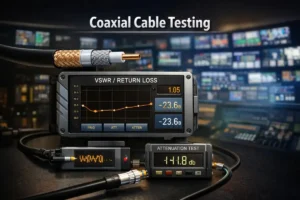
1. Coaxial Cable Testing (Video and RF)
Coax remains the workhorse of the studio for SDI signals. Key tests include:
- Continuity and Short Testing: Ensuring the center conductor and shield are intact and not touching.
- Return Loss & VSWR: Measuring how much signal is reflected back toward the source. High return loss is often caused by kinks or poor crimping.
- Attenuation (Signal Loss): Checking if the signal strength at the destination meets the minimum requirements for the specific cable length and frequency.
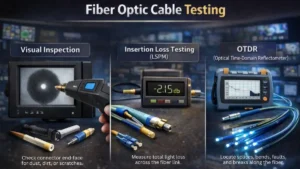
2. Fiber Optic Cable Testing
As broadcasters migrate to IP-based workflows, fiber is essential.
- Visual Inspection: Using a fiber scope to check for dust or scratches on the end-face—the #1 cause of fiber failure.
- Insertion Loss Testing (LSPM): Measuring the total light lost from one end to the other.
- OTDR (Optical Time-Domain Reflectometer): Mapping the entire fiber run to identify the exact location of splices, bends, or breaks.
If you are currently designing a new studio layout and need technical guidance on which testing parameters are most relevant for your specific distance runs, you can Ask an Expert at Remee to get professional insights tailored to your project.
Achieving Broadcast Certification: Procedures and Protocols
To reach the gold standard of broadcast certification, simple “pass/fail” continuity tests are not enough. Certification involves comparing the measured performance of a cable against international standards (such as TIA/EIA or SMPTE).
Key Certification Steps:
- Calibration: Ensuring the testing equipment is calibrated to the specific NVP (Nominal Velocity of Propagation) of the cable being tested.
- Verification: Running a full suite of tests including NEXT (Near-End Crosstalk) and ACR-F (Attenuation-to-Crosstalk Ratio, Far-end) for data cables.
- Documentation: Storing the digital results for every single link. This is vital for warranty purposes and future troubleshooting.
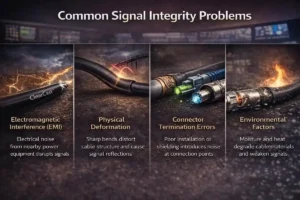
Common Signal Integrity Problems and Their Causes
Even with high-quality cable certification protocols in place, problems can arise. Understanding the “why” behind a failure is the first step toward a solution.
- Electromagnetic Interference (EMI): Often caused by routing Broadcast Cable too close to power lines or high-voltage lighting ballasts.
- Physical Deformation: Copper coax and fiber optics have strict “minimum bend radii.” If a cable is bent too sharply around a corner, the internal geometry changes, leading to signal reflections and impedance mismatches.
- Connector Termination Errors: The majority of signal issues occur at the ends. Poorly shielded connectors or improper stripping of the cable jacket can introduce noise into the system.
- Environmental Factors: Moisture ingress in outdoor broadcast trucks or high-heat environments can degrade the cable jacket over time, leading to premature signal attenuation.
Why Quality Cable Matters: The ClearCast™ Advantage
Testing verifies performance. Cable design determines how well performance holds over time.
Remee’s ClearCast™ Broadcast Cable line is engineered specifically for demanding broadcast environments. Features such as precision-drawn copper conductors, high-velocity dielectrics, and robust shielding improve measurable results during cable testing and support long-term reliability.
Premium construction enhances:
- Return loss consistency
- Reduced attenuation over distance
- Shield effectiveness
- Mechanical durability
When selecting materials for 12G-SDI coax or tactical fiber assemblies, product quality directly impacts cable certification outcomes.
If you need detailed specifications or technical documentation to evaluate ClearCast™ for your next project, you can Request for Information at Remee.
Choosing quality materials simplifies signal integrity testing and reduces long-term risk.
Broadcast operations operate with zero tolerance for signal disruption. Structured cable testing, disciplined signal integrity testing, and formal cable certification protect production environments from costly downtime.
Quality Broadcast Cable infrastructure, combined with rigorous validation protocols, creates a foundation of reliability. Remee’s ClearCast™ line supports industry standards with engineered precision designed for modern broadcast demands.
Do not leave your signal path to assumption. Begin every project with verified infrastructure and documented performance assurance.
FAQ:
Q1: What is the difference between verification and certification?
A: Verification simply checks if a cable is connected correctly (continuity). Certification uses specialized tools to prove the cable meets specific performance standards (like Category 6A or SMPTE 311) for bandwidth and interference resistance.
Q2: Why is Return Loss so important in broadcast coax?
A: In high-frequency video transmission, any irregularity in the cable (like a kink) causes the signal to “bounce” back. This return loss can cause ghosting in analog signals or “bit errors” in digital signals, leading to total signal loss in 12G-SDI environments.
Q3: How often should broadcast cables be re-tested?
A: While permanent installs should be tested and certified upon completion, cables in “mobile” environments (like OB trucks or patch bays) should be tested annually or whenever physical wear is visible, as constant plugging and unplugging degrades signal integrity.
Q4: Can I use standard network cables for broadcast IP video?
A: While standard Cat 6 might work for basic data, Broadcast Cable like ClearCast™ is often designed with better shielding (S/FTP) and more durable jackets to handle the continuous high-bandwidth streams and physical demands of a production environment without dropping packets.