1kV vs. 2kV PV Wire: Choosing the Right Voltage Rating for Your Solar Farm
Summary: Higher string voltages are now standard in utility-scale solar farms, but choosing between 600V, 1kV, and 2kV PV wire can significantly affect long-term performance and safety. This guide explains insulation requirements, module and inverter coordination, and when to move to higher voltage ratings. It also highlights Remee’s XLPE-insulated solar photovoltaic cable options for copper and aluminum conductors, helping designers balance efficiency, durability, and code compliance.
As solar farm DC voltages increase to improve efficiency and reduce balance-of-system costs, many projects still rely on legacy 600V cabling never intended for modern string architectures. Today’s utility-scale arrays commonly operate at 1 kV or 1.5 kV DC, with growing interest in 2 kV-rated PV wire to future-proof large installations and demanding environments. Selecting the wrong voltage rating can limit string length, complicate layouts, and introduce long-term reliability or compliance risks.
Understanding PV Wire Voltage Ratings
PV-rated conductors are single-conductor, sunlight-resistant cables designed to interconnect solar modules and link arrays to DC collection equipment. The voltage rating defines the maximum continuous operating voltage that the cable can safely withstand under applicable standards.
Remee offers copper photovoltaic wiring rated at 600V, along with 1kV and 2kV options. All constructions use XLPE insulation and are engineered for harsh outdoor conditions, including applications where direct burial is permitted.
Why Solar Farms Are Moving Beyond 600V
The transition away from 600V DC in large commercial and utility-scale projects is driven by both economic and technical advantages. Higher DC voltages reduce current for a given power level, lowering resistive losses and enabling more efficient solar farm cable layouts.
Key advantages of moving to 1 kV or higher include:
- Longer strings with fewer combiners and reduced DC hardware
- Lower I²R losses, improving overall system efficiency
- Reduced trenching and conduit requirements across large sites
Remee’s renewable energy portfolio reflects this shift, offering copper and aluminum solar cable constructions rated for 1 kV and 2 kV service in array wiring and DC feeder applications.
Insulation Requirements at 1 kV vs. 2 kV
As system voltage rises, electrical stress on cable insulation increases. XLPE (cross-linked polyethylene) insulation is widely used in photovoltaic applications due to its high dielectric strength, thermal stability, and resistance to moisture and UV exposure.
Remee’s 1 kV and 2 kV solar photovoltaic cable solutions use XLPE compounds formulated for high-voltage PV environments and compliance with UL 44, UL 854, and UL 4703, supporting long service life in utility-scale conditions.
Module Matching and System Design Considerations
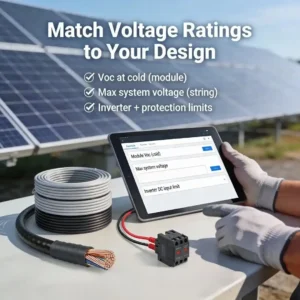
Voltage ratings must align with:
- Module open-circuit voltage (Voc) at the lowest expected temperature
- Maximum system voltage of the array or string
- Inverter DC input limits and protective device ratings
For example, 1kV systems operating close to their design limits often benefit from 2kV-rated cabling, which provides additional margin for cold-weather Voc rise and future design changes. Remee supplies copper conductors in #12, #10, #8, and #6 AWG at 1 kV and 2 kV, as well as aluminum DC feeder solar farm cable for large collection circuits.
When to Upgrade from 600V to 1kV or 2kV
Upgrading from 600V infrastructure is recommended when:
- Designing new utility-scale or large commercial solar farms
- Extending string length to reduce combiner count
- Repowering sites with higher-voltage inverters
- Building in high-UV, high-temperature, or corrosive environments
Remee’s Renewables™ line includes 600V copper options alongside 1kV and 2kV copper and aluminum products, all produced under ISO 9001-certified manufacturing processes.
Remee XLPE-Insulated Options for Solar Arrays
Copper and Aluminum Choices
Remee manufactures:
- Copper solar photovoltaic cable rated 1 kV and 2 kV with stranded bare or tinned copper conductors
- 600V copper solar cable with XLPE insulation for lower-voltage architectures
- Aluminum DC feeder solar farm cable rated 1 kV and 2 kV using compact stranded AA-8000 Series conductors
These constructions support both module interconnections and long-distance DC collection to inverters and substations.
To determine the best option for your system, you can Ask an Expert at Remee for guidance on conductor sizing, voltage rating, and environmental exposure.
PV Wire vs. Other Solar Cables
While “solar cable” is often used generically, there are important distinctions between PV wire and other cable families used in renewable energy installations.
| Cable Type | Typical Use Case |
Key Features |
|
Photovoltaic wiring |
Module interconnection and array wiring | Sunlight-resistant, XLPE insulation, 600V or 1kV/2kV ratings. |
|
DC feeder solar cable |
Collection from combiner boxes to inverters |
Larger copper or aluminum conductors, often 1 kV/2 kV rated. |
|
MV primary distribution |
Output from the substation to the grid connection |
TR-XLPE insulation, 35 kV ratings, direct burial capability. |
| Substation/control cable |
Protection, control, and communication circuits |
Copper and fiber constructions, shielded or unshielded. |
Understanding where each solar photovoltaic cable type fits ensures proper performance from the module level through grid interconnection.
When 2 kV PV Wire Becomes the Better Choice
Designers consider 2kV-rated Photovoltaic wire in several scenarios:
- Very long strings or higher-voltage DC architectures where extra headroom improves safety margins.
- Projects in regions with extreme cold, where Voc can rise well above nameplate values.
- Utility-scale projects where future repowering or expansion may push system voltages higher.
Remee’s 1kV/2kV PV wire constructions give EPCs and developers flexibility to standardize on a robust cable platform that supports current needs while leaving room for higher string voltages and system upgrades.
Choosing between 600V, 1kV, and 2kV Photovoltaic wire is no longer a simple code requirement. It is a strategic decision that affects efficiency, system layout, and long-term reliability. By aligning voltage ratings with modules, inverters, and environmental conditions, and by using durable XLPE-insulated solar farm cable, developers can protect performance and project returns.
To refine your voltage and cabling strategy, Request Information from Remee for application-specific guidance.
FAQ:
Q1: Can 600V-rated conductors be used in a 1kV solar farm?
A: No. Cable voltage ratings must meet or exceed the system’s maximum voltage to avoid insulation stress, failure, and non-compliance.
Q2: What is the advantage of XLPE insulation in solar cabling?
A: XLPE provides high dielectric strength, thermal stability, and UV resistance, which are critical for long-term outdoor performance.
Q3: When should aluminum solar photovoltaic cable be used instead of copper?
A: Aluminum DC feeder cables are ideal for long collection runs where weight and cost are key factors, especially in large utility-scale projects.
Q4: Why does ISO 9001 certification matter for cable suppliers?
A: ISO 9001 ensures consistent manufacturing quality and traceability, supporting reliable performance in critical renewable energy systems.