Understanding Broadcast Cable Ratings: CMP, CMR, and Environmental Considerations
Summary: Broadcast cable ratings matter more than many installers realize. These ratings keep systems safe, code-compliant, and ready for demanding broadcast environments. This guide explains CMP, CMR, CL3P, and CL3R flame ratings, how they differ, and when each rating is required. You’ll also gain a clear view of plenum vs riser cable, environmental needs, and how to choose the right Remee cable for each installation.
Broadcast cable installation facilities are packed with cables running above ceilings, between floors, and through studios, control rooms, and equipment racks. In a fire, these cables can act as fuel or a pathway for smoke and flame if they are not properly rated. Fire‑resistant jackets and correct code classifications are the first line of defense for occupants and equipment.
Article 800 of the National Electrical Code (NEC) defines communications cable ratings such as CMP and CMR, while other NEC Articles define power‑limited Class 2 and Class 3 ratings (including CL3P and CL3R). These ratings apply to the jacket, not to bandwidth or signal performance, but they determine where a cable can legally and safely be installed inside a building.
Broadcast Cable Ratings: CMP, CMR, CL3P, CL3R
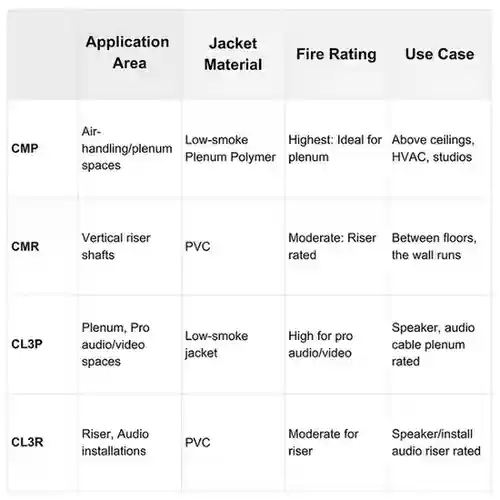
These common ratings all appear in broadcast, AV, and IPTV installations, but each serves a distinct purpose. Understanding them helps ensure that your chosen Remee cables match the environment and the local AHJ (Authority Having Jurisdiction) expectations.
CMP (Communications Plenum)
- Highest standard communications jacket rating for indoor use.
- Intended for ducts, plenums, and other air‑handling spaces (e.g., above drop ceilings used for return air).
CMR (Communications Riser)
- Communications riser cable for vertical shafts or riser spaces between floors.
- Designed to limit flame spread vertically so a fire on one floor does not quickly migrate to others.
CL3P (Class 3 Plenum)
- Power‑limited Class 3 cable for plenum spaces, used when the circuit carries higher voltages than Class 2 while remaining power‑limited.
- Must pass more stringent plenum flame and smoke tests, similar in concept to CMP but for power‑limited circuits instead of communications only.
CL3R (Class 3 Riser)
- Power‑limited Class 3 cable approved for riser spaces between floors.
- Not acceptable in plenums, but suitable for vertical riser shafts and many in‑wall broadcast power‑limited applications.
In general, higher‑rated jackets (plenum) can substitute for lower‑rated environments (riser or general purpose), but not the reverse. For example, CMP or CL3P can be used in risers, but CMR or CL3R cannot be used in plenum spaces.
Plenum vs Riser Cable in Broadcast Facilities
Plenum vs Riser cable is one of the most important distinctions for broadcast engineers and installers working in multi‑story or commercial spaces. Plenum cable is required wherever the cable is installed in an air‑handling space, while riser cable is intended for vertical runs between floors.
Plenum vs Riser Cable: Understanding the Key Differences in Broadcast Applications
Location
- Plenum: Air‑handling spaces such as return‑air drop ceilings or raised floors used for HVAC circulation.
- Riser: Vertical shafts, sleeves, or conduits connecting multiple floors (e.g., MDF to IDF to studios).
Fire and smoke performance
- Plenum (CMP/CL3P): Must limit flame propagation to a short distance and produce low smoke and reduced toxicity.
- Riser (CMR/CL3R): Tested for vertical flame spread but with less stringent smoke and toxicity requirements.
For broadcast applications, selecting the correct plenum or riser Remee ClearCast cable helps protect on‑air continuity and complies with building and fire codes, especially in large venues like arenas, convention centers, and studios.
CMP vs CMR Cable: How to Choose for Each Installation
Understanding cmp vs cmr cable in context makes code decisions easier during design and installation. The following simplified scenarios illustrate where each rating is typically required.
Use CMP (or CL3P) when:
- Running broadcast signal or control cables in air‑handling ceiling spaces across studios or open office areas.
- Routing camera, intercom, or IP audio cables through plenum return‑air paths in large production facilities or houses of worship.
Use CMR (or CL3R) when:
- Running vertical backbones between floors, from central technical spaces to remote studios or rack rooms.
- Installing riser feeds for IP distribution, IFB, or control networks in non‑air‑handling shafts or vertical conduits.
Because the jacket rating does not affect bandwidth, a Remee ClearCast™ cable with a CMP jacket will have similar electrical performance to a CMR version of the same construction, which changes the fire and smoke behavior of the jacket material.
If you are unsure which rating your application needs, you can connect with Remee’s technical specialists through the Ask an Expert interface to review your floor plans, local code requirements, and environmental conditions before specifying a product.
Key Differences in Installation
Environmental Considerations for Broadcast Cable Installation
The physical environment affects cable selection just as much as flame rating. Broadcast systems run across diverse conditions from hot mechanical rooms to outdoor feeds. Remee designs cable jacketing and shielding to support these environments.
Key environmental points:
Indoor vs outdoor transition
Use properly rated outdoor or OSP jackets with UV and moisture resistance when leaving the building envelope, and transition to CMP or CMR inside.
Temperature and mechanical stress
Avoid exceeding bend radius, tensile load, or temperature ratings, especially around cameras on booms, stage boxes, or mobile production carts.
Toxicity and low‑smoke options
In spaces with dense occupancy (broadcast studios, theaters, stadiums), low‑smoke and low‑toxicity jackets help minimize risk during evacuations.
Selecting the correct broadcast cable rating (CMP, CMR, CL3P, or CL3R) is non-negotiable for code compliance, installation safety, and uninterrupted AV performance. With Remee’s full range of ClearCast™ cables tailored for every environment, you can install with confidence and peace of mind.
Have a project with unique cable installation needs or strict code requirements? If Remee’s standard Clearcast™ Cables are not suitable for the need, Request a New Custom Cable.
FAQ: Broadcast Cable Ratings and Installation
Q1: How do broadcast cable ratings affect code compliance?
A: Authorities Having Jurisdiction (AHJs) and building inspectors rely on markings like CMP, CMR, CL3P, and CL3R to quickly verify that installed cables match the building space type. Using a lower‑rated cable where a higher rating is required can result in failed inspections, rework costs, and increased life‑safety risk in the event of a fire.
Q2: Can a plenum cable be used everywhere in a broadcast facility?
A: Plenum‑rated communications cables (CMP) and Class 3 cables (CL3P) generally may be used in riser and standard in‑wall applications, effectively substituting for CMR and CL3R in many cases. However, the reverse is not permitted; a CMR or CL3R cable cannot be installed in plenum air spaces unless enclosed in an approved metal raceway that meets code.
Q3: How do plenum cable vs riser cable choices influence cost?
A: CMP and CL3P cables tend to be more expensive because they use high‑performance flame‑retardant, low‑smoke jacket materials and undergo more stringent testing. Many broadcast projects, therefore, use a mix: plenum cables where required and riser cables elsewhere, balancing safety, compliance, and budget.
Q4: How do CL3P and CL3R fit into broadcast system design?
A: CL3P and CL3R apply to power‑limited Class 3 circuits, which are common in certain control, audio, and low‑voltage power applications in AV and broadcast systems. CL3P should be used where these circuits enter plenum spaces, while CL3R is used for riser applications or in‑wall runs between floors that are not air‑handling. When both communications and power‑limited circuits share the same path, each cable must carry a rating appropriate to that environment.