Understanding PoE, PoE+, and PoE++: How to Choose the Right LAN Cable for High-Power Devices
As buildings become smarter and more connected, networked devices are demanding more power than ever. Security cameras, wireless access points, video displays, access control systems, LED lighting, sensors, and building automation devices increasingly rely on Power over Ethernet (PoE) to receive both data and electrical power through a single LAN cable.
This approach can simplify installation by reducing the need for separate power infrastructure. However, as power requirements increase, choosing the right PoE standard and LAN cable becomes increasingly important. Cable construction, conductor size, installation conditions, bundle density, and cable length can all affect reliable power delivery.
Understanding the differences between PoE, PoE+, and PoE++ is a good starting point for designing a dependable network.
What Is Power over Ethernet?
Power over Ethernet allows compatible network equipment to transmit electrical power and data over Ethernet cabling. Instead of installing a separate power connection for every device, a PoE-enabled switch or injector can provide power through the same cable used for network communication.

This can help simplify installations, reduce cable clutter, and provide greater flexibility when deploying devices in locations where traditional electrical outlets may be difficult or expensive to install.
As connected building technologies continue to expand, PoE is increasingly being used for devices such as IP cameras, wireless access points, VoIP phones, access control equipment, sensors, and other networked systems.
But not all PoE systems deliver the same amount of power.
PoE vs. PoE+ vs. PoE++: What’s the Difference?
The IEEE 802.3 family of standards has evolved to support devices with increasingly higher power requirements.
| Standard | Common Name | Maximum PSE Power | Typical Application |
| IEEE 802.3af | PoE | 15.4 W | VoIP phones, basic cameras, sensors |
| IEEE 802.3at | PoE+ | 30 W | Higher-performance cameras, access points |
| IEEE 802.3bt Type 3 | PoE++ | 60 W | Advanced access points, PTZ cameras, displays |
| IEEE 802.3bt Type 4 | PoE++ | 90 W | High-power connected devices |
The figures above represent power available from the Power Sourcing Equipment (PSE). The powered device (PD) receives less because some power is lost through the cable.
For example, IEEE 802.3af provides up to 15.4 W at the PSE, while the powered device can receive up to approximately 12.95 W. IEEE 802.3at provides 30 W at the PSE and approximately 25.5 W at the PD. IEEE 802.3bt increases this further, with Type 3 supporting up to 60 W and Type 4 up to 90 W at the PSE.
That progression is important because a device requiring more power may not operate correctly when connected to an infrastructure designed for a lower PoE class.
Why Your LAN Cable Matters for High-Power PoE
Selecting a PoE-capable switch is only part of the equation. The LAN cable itself plays an important role in delivering power reliably.
When electrical current travels through copper conductors, some energy is converted into heat. As PoE power levels increase, thermal considerations become more important. Large cable bundles can restrict heat dissipation, potentially increasing conductor temperatures and affecting cable performance.
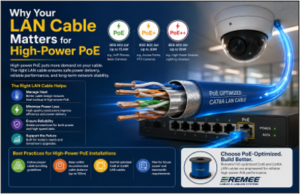
For high-power applications, installers should consider cable construction, conductor size, ambient temperature, bundle size, installation method, and the expected power requirements of connected devices.
A properly selected LAN cable can help maintain reliable data transmission while supporting the power demands of modern PoE equipment.
Cat6 and Cat6A for Modern PoE Applications
Cat6 and Cat6A cabling are commonly considered when networks need higher performance and greater bandwidth alongside PoE capabilities.
Remee offers PoE-oriented Category 6 and Category 6A cable options as part of its Activate™ Powered Cable Solutions portfolio. Its product range includes various Cat6 and Cat6A constructions designed for PoE applications, including shielded and unshielded configurations and different jacket ratings for commercial, riser, plenum, and outdoor environments.
Choosing between Cat6 and Cat6A should depend on the complete requirements of the installation, including data rates, environmental conditions, cable routing, PoE power levels, and future network expansion.
For new infrastructure, considering future power and bandwidth requirements early can help prevent costly cable replacement later.
Don’t Overlook Cable Heating and Bundling
One of the most important considerations in high-power PoE installations is heat.
Higher PoE power means more electrical current traveling through the conductors. When many powered cables are installed together in dense bundles, the combined heat generated by the cables can become a design consideration.
This does not mean that high-power PoE cannot be deployed in cable bundles. Rather, it means the installation should be planned carefully. Cable construction, conductor gauge, bundle size, ambient temperature, and applicable installation requirements should all be evaluated.
A LAN cable selected specifically for the expected PoE load can provide a stronger foundation for reliable long-term performance.
What About PoE Beyond 100 Meters?
Standard Ethernet channels are generally designed around a maximum 100-meter channel length. This can become a challenge in large buildings, campuses, transportation facilities, industrial environments, and other installations where powered devices are located far from network equipment.
This is where alternative powered cable solutions can become useful.
Remee’s Activate™ Powered Cable Solutions include standard Category PoE cables as well as PowerPipe™ copper distribution and hybrid cable configurations intended for longer-distance applications.
Hybrid constructions can combine fiber optic connectivity with copper power conductors, helping address installations where both extended data distance and power delivery are required.
Explore Remee’s LAN & Premise Cable Solutions
How to Choose the Right LAN Cable for PoE
When selecting a LAN cable for a PoE installation, consider these factors:
- Device power requirements: Determine how much power the connected device actually needs.
- PoE standard: Match the network equipment and cabling strategy to IEEE 802.3af, 802.3at, or 802.3bt requirements.
- Cable construction: Consider Cat6 or Cat6A, conductor size, shielding, and jacket rating.
- Bundle conditions: Evaluate the number of cables grouped and the surrounding installation environment.
- Distance: Confirm that the planned cable length supports both the required data performance and power delivery.
- Future requirements: Consider whether additional power or bandwidth may be needed as the building evolves.
Building a More Reliable PoE Infrastructure
PoE has evolved significantly from its original role in powering relatively low-demand devices. With IEEE 802.3bt supporting substantially higher power levels, Ethernet infrastructure can now support a broader range of connected building technologies.
However, higher power also places greater demands on the cabling infrastructure. The right LAN cable should therefore be selected based on the complete application—not simply the connector or network speed.
For standard PoE deployments, appropriately specified Cat6 and Cat6A cables can provide a strong foundation. For applications that require greater power, longer distances, or a combination of high-speed data and power, solutions such as Remee’s Activate™ Powered Cable Solutions can provide additional options.
By considering power, bandwidth, cable construction, heat, bundle density, and distance during the design stage, network professionals can build infrastructure that is ready not only for today’s connected devices but also for tomorrow’s smarter buildings.
Frequently Asked Questions
1. What is the difference between PoE, PoE+, and PoE++?
PoE (IEEE 802.3af) provides up to 15.4 W from the PSE, PoE+ (IEEE 802.3at) provides up to 30 W, and PoE++ (IEEE 802.3bt) extends power delivery to 60 W for Type 3 and up to 90 W for Type 4.
2. Can Cat6 cable be used for PoE?
Yes. Cat6 is widely used for PoE applications and is included among Remee’s PoE cable offerings. The appropriate cable construction should be selected based on power, bandwidth, installation environment, and other project requirements.
3. Is Cat6A better for high-power PoE?
Cat6A can be an appropriate choice where higher bandwidth and future network capacity are important. However, cable selection should consider the complete application rather than assuming one category is always better.
4. Does PoE make LAN cables hotter?
Power flowing through copper conductors generates heat. As PoE power increases and cable bundles become denser, thermal management becomes increasingly important. Proper cable selection and installation planning can help address these considerations.
5. Can PoE run beyond 100 meters?
Standard PoE over conventional Ethernet cabling is generally associated with a 100-meter channel limit. For applications requiring longer distances, specialized powered cable solutions can provide additional options. Remee’s Activate™ portfolio includes PowerPipe™ copper and hybrid solutions designed for longer-distance applications.
6. What should I consider when choosing a PoE LAN cable?
Consider the device’s power requirements, PoE standard, cable category, conductor construction, bundle size, installation environment, distance, bandwidth requirements, and future expansion plans.
7. Where can I find PoE cable solutions from Remee?
Remee offers Category PoE cables and Activate™ Powered Cable Solutions for applications requiring combinations of data and power.