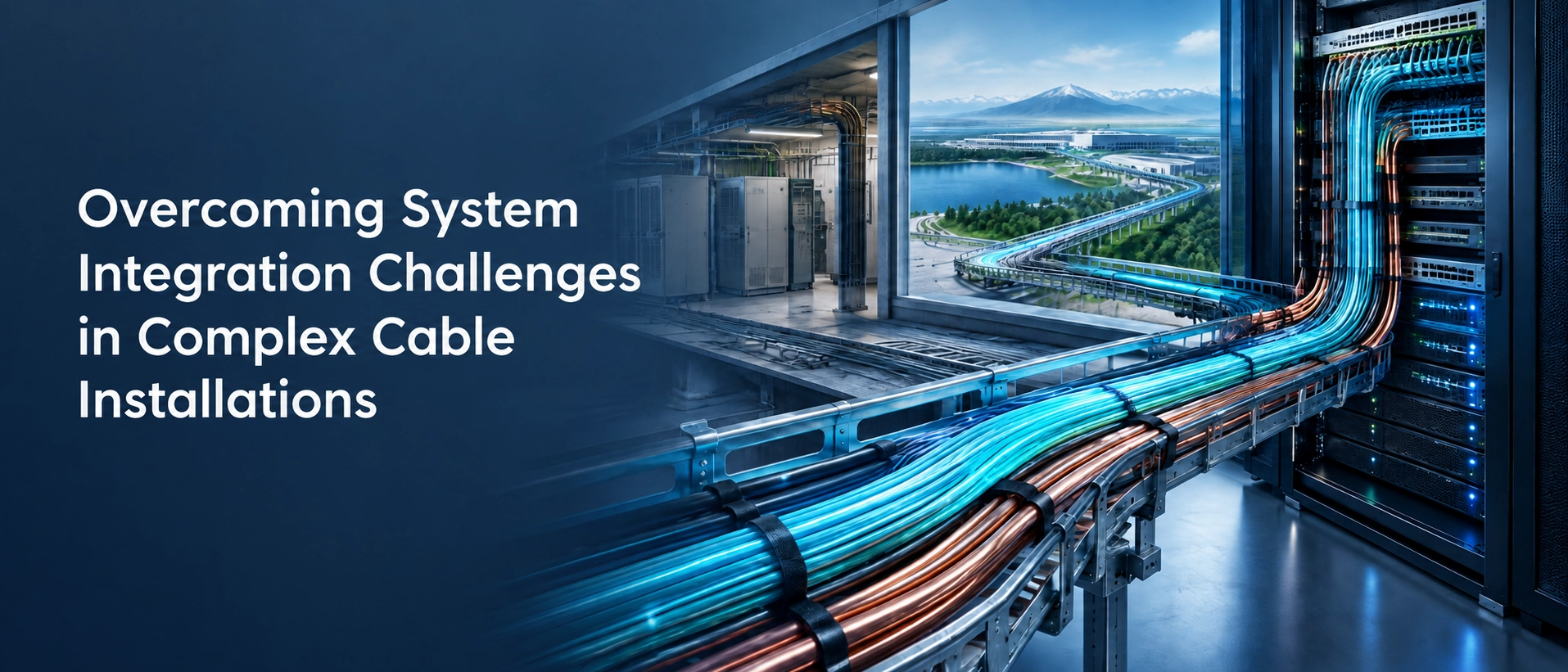
Overcoming System Integration Challenges in Complex Cable Installations
Modern system integration projects are becoming more connected, but that connectivity brings a practical challenge: how can you deliver high-speed data and reliable power without turning the installation into a maze of cables?
From crowded equipment racks and complex cable routing to legacy infrastructure that was never designed for today’s bandwidth demands, system integrators must find efficient ways to manage both fiber-optic cables and power cable requirements within increasingly complex environments.
The right cabling strategy can make a significant difference not only in installation efficiency but also in scalability, reliability, space management, and long-term system performance.
By considering fiber optic cables, power cable configurations, and hybrid cabling solutions early in the integration process, teams can create a more streamlined infrastructure built to support evolving connectivity needs.
Explore Remee’s Activate™ Powered Cable Solutions to discover cabling options designed for demanding system integration applications.
The Growing Complexity of System Integration

Today’s buildings, industrial facilities, transportation systems, campuses, and data environments depend on an ever-growing number of connected devices. Wireless access points, security cameras, IoT sensors, automation systems, distributed antenna systems, smart-building technologies, and network equipment all require reliable and efficient connectivity.
Traditionally, these systems may rely on separate cabling for data and power. As connected devices continue to increase, so does the infrastructure needed to support them. More cables can mean longer installation times, greater demands on available space, and more complex maintenance and future upgrades.
For system integrators, the challenge is not simply selecting a cable that can transmit a signal or deliver power. It is about developing a cabling infrastructure that integrates copper or fiber-optic cables and power requirements efficiently while supporting the entire system architecture.
Challenge 1: Excessive Cabling Requirements
One of the most common problems in complex installations is the sheer volume of cabling.
When power and data are delivered through separate pathways, installers may need to make multiple cable pulls to reach a single endpoint. In large-scale environments, this can quickly increase installation time and create congestion in pathways, trays, ceilings, and equipment rooms.
A more integrated approach can help reduce this complexity. Hybrid and composite cable designs can combine different transmission requirements within a single overall cable construction, reducing the need for multiple individual pulls.
Remee’s PowerPipe™ hybrid cables, for example, combine copper power conductors with fiber in a single cable construction. These solutions are designed for applications where extended distance and higher bandwidth are required, including distributed antenna systems, cellular and 5G micro-cell applications, and passive optical networks.
Challenge 2: Limited Rack and Pathway Space
Space is another major consideration for system integrators.
Equipment rooms and network racks often have limited capacity. As additional systems are introduced, cable bundles can become increasingly difficult to manage. Excessive cabling can make access more challenging and complicate future maintenance or expansion.
This is where cable consolidation can provide an advantage.
Instead of treating every connectivity requirement as a separate installation, integrators can evaluate whether multiple requirements can be addressed through a converged cabling strategy. Combining power and data functions where appropriate can reduce cable volume and simplify routing.
Remee notes that its bundled and composite cable constructions allow multiple signals to travel under one overall jacket, meaning installers can potentially complete an installation with a single cable pull rather than multiple pulls.
Challenge 3: Legacy Infrastructure
Not every integration project starts with a clean slate.
Many facilities must incorporate new technologies into buildings and systems that already contain a legacy infrastructure. Replacing the entire cabling system may not be practical, cost-effective, or necessary.
System integrators therefore need solutions that can work within existing constraints while providing a path toward modernization.
This requires careful consideration of factors such as:
- Existing cable pathways and space limitations
- Required bandwidth
- Power requirements
- Installation environment
- Distance between network equipment and endpoints
- Future expansion requirements
A customized cable design can help bridge the gap between existing infrastructure and new system requirements. Instead of forcing the project into a standard configuration, the cable itself can be designed around the application.
Where Fiber Optic Cables and Power Need to Work Together
Bandwidth requirements continue to increase as more devices become connected. Fiber optic cables are particularly valuable in applications where high bandwidth and longer transmission distances are required.
However, fiber alone does not deliver electrical power to many remote devices. This can create a design challenge when an endpoint requires both high-speed data connectivity and power.
Hybrid cabling provides one way to address this requirement.
Remee’s PowerPipe™ hybrid solutions combine fiber and copper within a composite cable design. The company’s available configurations include single-mode OS2 fiber alongside copper power conductors, with different conductor sizes and construction options available for application-specific requirements.
This approach can be particularly useful for systems such as DAS, 5G micro-cells, and passive optical networks, where high-bandwidth connectivity may need to be delivered alongside power.
Choosing the Right Power Cable Strategy
Power requirements can vary considerably from one integration project to another. A small, connected device may require relatively little power, while distributed infrastructure can demand significantly more over longer distances.
This is why choosing the right power cable should involve more than simply selecting a conductor size. Integrators need to consider distance, voltage, current, wattage, environment, safety requirements, and the overall architecture of the system.
Remee’s Activate™ Powered Cable Solutions include standard PoE cables as well as PowerPipe™ copper and hybrid cable configurations. The company states that its copper PowerPipe™ solutions are designed for Class 4 fault-managed power applications and can support power distribution over longer distances than conventional PoE approaches.
The right solution can help integrators reduce reliance on additional intermediate power equipment while simplifying the overall installation strategy.
Custom Cable Designs for Application-Specific Requirements
Every integration project has its own set of constraints. A standard off-the-shelf cable may work for one application but create challenges in another.
Custom cable design can help address requirements such as:
- Specific fiber counts
- Different copper conductor sizes
- Shielding configurations
- Jacket and insulation materials
- Water blocking
- Armoring
- Messenger requirements
- Indoor, outdoor, plenum, or riser applications
- Composite or Siamese constructions
Remee offers modified standard and custom PoE and PowerPipe™ cable solutions, allowing cable constructions to be adapted to specific application requirements.
This flexibility is particularly valuable when system integrators are working on projects where space, distance, environmental conditions, and power or bandwidth requirements cannot be addressed effectively through a standard cable configuration.
Building a More Efficient Integration Strategy
Overcoming cable installation challenges starts with considering the cabling architecture early in the design process.
Rather than asking only, “What cable do we need?”, system integrators should ask:
What combination of power, data, distance, bandwidth, environment, and future expansion does this system require?
From there, a converged or hybrid approach may help reduce cable pulls, simplify installation, optimize available space, and create a more adaptable infrastructure.
This does not mean that every project should use hybrid cabling. The best approach depends on the specific application and technical requirements. However, evaluating these options early can help prevent cabling constraints from becoming an expensive problem later in the project.
Smarter Approach to System Integration
Complex system integration does not have to mean unnecessarily complicated cabling. By combining thoughtful infrastructure planning with fiber optic cables, power delivery, hybrid constructions, and application-specific cable designs, integrators can build systems that are easier to install, manage, and expand.
For projects where conventional cabling approaches create challenges, Remee offers a range of Activate™ Powered Cable Solutions, including PoE, PowerPipe™ copper, and PowerPipe™ hybrid configurations designed for different power, bandwidth, and distance requirements. Its custom cable capabilities can also help address unique system integration needs.
Looking for a cable solution tailored to your next system integration project?
Explore Remee’s Activate™ Powered Cable Solutions and connect with the team to discuss your specific requirements.
Explore Activate Powered Cable Solutions by Remee
Frequently Asked Questions
- What are the main cabling challenges in complex system integration projects?
Common challenges include excessive cabling, limited rack and pathway space, difficult cable management, long-distance power delivery, and integrating new systems with legacy infrastructure.
- When should system integrators consider hybrid cabling?
Hybrid cabling can be useful when an application requires both high-bandwidth data transmission and power delivery. Combining these functions into a single cable can help simplify installation and reduce the number of cable pulls. - What are the benefits of using fiber optic cables in system integration?Fiber optic cables provide high bandwidth and are well suited for applications requiring reliable data transmission over longer distances. They can also help support the increasing connectivity demands of modern systems.
- How can custom cable designs help overcome installation challenges?
Custom cable designs can be tailored to specific requirements such as fiber count, conductor size, shielding, environmental conditions, cable construction, and power or bandwidth needs. This allows integrators to address project-specific constraints more effectively. - How can Remee help with complex cable installation requirements?
Remee offers Activate™ Powered Cable Solutions, including PoE, copper PowerPipe™ cables, and hybrid PowerPipe™ cable configurations. These solutions can combine power and fiber connectivity to help system integrators simplify installations and address specific power, bandwidth, and distance requirements.