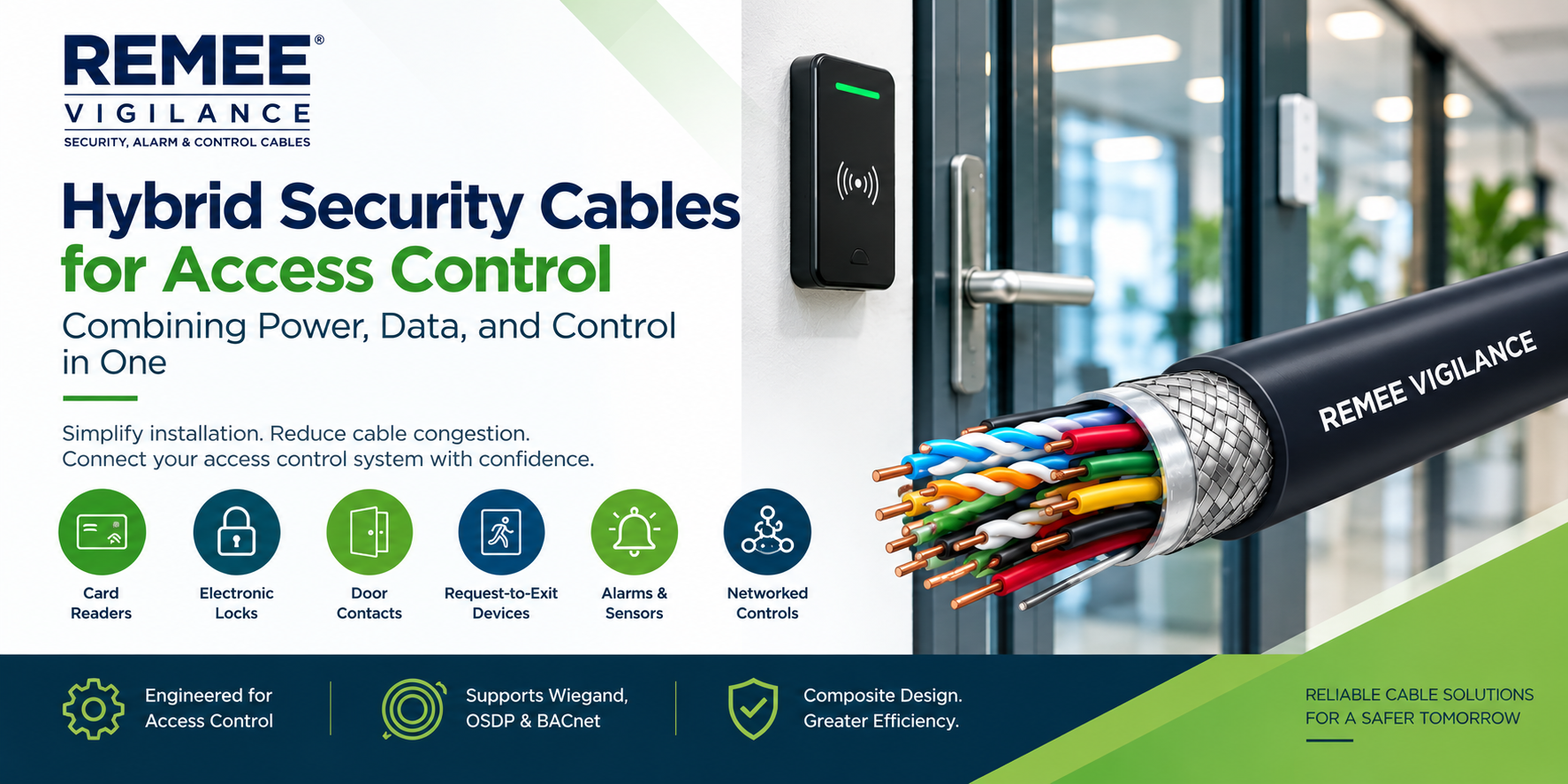
Hybrid Security Cables for Access Control: Combining Power, Data, and Control in One
Security systems are becoming more connected, intelligent, and responsive. Modern access control is no longer limited to a card reader and an electronic lock.
Today’s systems can integrate readers, door contacts, request-to-exit devices, sensors, alarms, and networked controls, creating a growing demand for reliable cabling infrastructure. But as the number of connected components increases, so does the challenge of getting multiple cables from a central location to the same access point.
This is where hybrid security cables can make a difference. By combining multiple conductors and cable components into a single jacket, these solutions can simplify installation, reduce cable congestion, and make it easier to connect the various elements of an access control system.
Remee’s Vigilance composite cables are engineered with these requirements in mind, offering configurations designed for access control technologies such as Wiegand, OSDP, and BACnet.
Explore Remee’s Vigilance Security, Alarm & Control Cables and find a cable solution designed to simplify your next access control installation.
Why Access Control Cabling Is Becoming More Complex
An access-controlled door may appear simple from the outside, but several components can operate behind it.
Depending on the application, an installation may need to accommodate:
- Card or credential readers
- Electronic locks
- Door position sensors
- Request-to-exit devices
- Alarm or monitoring circuits
- Motion sensors
- Horns or other notification devices
- Communication and control circuits
Each device can have different wiring requirements. Traditionally, this may mean running multiple individual cables from the access control panel to the door or device location.
As the number of controlled doors grows across an office, warehouse, campus, healthcare facility, or commercial building, the cost of individual cable runs can quickly add up. More cables can mean more conduit fill, more pulling and termination work, and greater difficulty keeping installations organized.
A hybrid approach provides another option.
What Are Hybrid Security Cables?
A hybrid security cable combines multiple cable components under a single overall jacket. Instead of treating every signal or device connection as a completely separate cable run, several requirements can be brought together into one composite construction.
For access control applications, this can mean combining components for data communication, power, readers, sensors, and other control functions within one cable assembly.
Remee’s Vigilance Access Control Composite Cables include configurations specifically developed for Wiegand and OSDP/RS-485 systems. Some designs incorporate shielded communication pairs alongside additional conductors for readers and other access control functions.
The goal is straightforward: make complex access control wiring easier to install and manage without compromising the requirements of the individual system components.
Simplifying Installation With One Cable Pull
One of the biggest advantages of composite security cables is installation efficiency.
When multiple cables are required for a single access point, installers have to manage separate cable pulls, pathways, and terminations. This can become particularly challenging when conduit space is limited or when cables need to travel long distances through crowded pathways.
Bundled and composite cables can consolidate multiple signals under one overall jacket. Remee specifically highlights bundling as a way to simplify installation because only one cable needs to be pulled instead of multiple individual cables.
This can help reduce the physical complexity of the installation while making cable identification and routing easier.
For large access control projects, even small improvements in installation efficiency can become significant when multiplied across dozens or hundreds of doors.
Reducing Conduit Fill and Cable Congestion
Conduit and pathway capacity are important considerations in security system design. When several individual cables are routed through the same pathway, available space can quickly become limited.
Hybrid security cables can help address this issue by consolidating multiple cable components into a single overall construction.
Instead of installing separate cables for every required function, a composite cable can bring several functions together. This can help reduce the number of individual cables occupying a pathway and potentially make better use of existing conduit capacity.
For system designers and installers working in retrofit environments, this can be especially valuable. Existing pathways may have limited space, making it difficult to add new security devices without modifying infrastructure.
Supporting Modern Access Control Technologies
Access control technology continues to evolve. Traditional Wiegand systems are increasingly being supplemented or replaced by technologies such as OSDP (Open Supervised Device Protocol) and other communication protocols.
These technologies can introduce different cabling requirements, particularly where shielded communication is needed.
Remee’s Vigilance™ range includes composite cable options designed for OSDP/RS-485 applications. For example, its product range includes plenum-rated configurations featuring shielded pairs for OSDP/RS-485 communication, as well as hybrid constructions designed for OSDP or Wiegand systems.
This gives system designers more flexibility when selecting a security cable for both current installations and evolving access control architectures.
Shielding for High-Noise Environments
Access control systems often operate alongside electrical equipment, lighting, automation systems, and other infrastructure that can introduce electromagnetic interference.
Signal integrity therefore matters, particularly for communication circuits.
Remee offers shielded composite cable configurations designed for environments where additional EMI protection is needed. Its Vigilance™ access control portfolio includes all-shielded composite constructions as well as shielded communication components for OSDP/RS-485 applications.
Selecting the appropriate shielded or unshielded construction should depend on the specific application, installation environment, and system requirements.
Choosing the Right Security Cable for the Application
Not every access control installation has the same requirements. Cable selection should take into account the technology being used, the installation environment, the required conductor sizes, pathway conditions, and applicable rating requirements.
For example, Remee offers Vigilance™ access control cables in configurations for:
- Wiegand systems
- OSDP/RS-485 systems
- Card-reader-only applications
- Hybrid OSDP or Wiegand systems
- Plenum-rated installations
- Riser-rated installations
- Wet-location and direct-burial applications
- High-EMI environments
Its access control portfolio includes plenum, riser, and outdoor/wet-location composite options, depending on the cable design.
This range allows integrators to select a construction based on the actual project environment rather than relying on a one-size-fits-all approach.
Customisation for Complex Security Systems
Standard products may not always align perfectly with a project’s requirements. A large security deployment may involve unique combinations of readers, sensors, locks, alarms, and control devices.
In such situations, custom cable design can help.
Remee offers modifications to standard security, alarm, and control cables as well as custom-made cable options. Available customization can include different jacket materials, conductor sizes, shielding configurations, conductor materials, non-standard jacket colors, and bundled cable constructions.
This flexibility can be particularly useful for system integrators managing specialized access control projects where standard cable configurations do not provide the ideal combination of power, communication, and control conductors.
The Bigger Benefit: A More Organized Security Infrastructure
The value of hybrid security cables goes beyond reducing the number of cables installed.
A more consolidated cabling architecture can help create an installation that is easier to understand, route, terminate, and maintain. Fewer individual cable runs can also help reduce visual and physical congestion around access control panels and pathways.
For integrators, the objective is not simply to install a cable. It is to create an infrastructure that supports reliable security operation while making the installation practical to deploy and maintain.
Hybrid cabling can be one part of that strategy.
Building Smarter Access Control Installations With Remee
As access control systems become more sophisticated, cabling needs to keep pace. Running separate cables for every reader, sensor, lock, and control function can add unnecessary complexity to an already demanding installation.
Hybrid security cables provide a smarter approach by bringing multiple conductors and functions together within a single composite construction. This can help simplify cable pulls, reduce pathway congestion and conduit fill, and support the diverse requirements of modern access control systems.
Remee’s Vigilance™ Security, Video, Alarm & Control Cables include composite solutions engineered for Wiegand, OSDP/RS-485, and other access control applications, with options for different installation environments and project requirements.
Whether you are designing a new access control system or upgrading an existing security infrastructure, choosing the right security cable can make the installation more efficient from the start.
Explore Remee’s Vigilance™ security and access control cable solutions to find a configuration suited to your application, or connect with Remee’s cable experts to discuss a custom solution.
Explore Remee’s Vigilance Security, Alarm & Control Cables
Frequently Asked Questions
1. What are hybrid security cables?
Hybrid security cables combine multiple cable components or conductors under one overall jacket. They can be designed to support different access control functions, such as communication, power, readers, sensors, and control circuits, within a consolidated cable construction.
2. How can hybrid cables simplify access control installations?
By combining multiple components into one cable, hybrid solutions can reduce the number of individual cable pulls required for an access point. This can simplify routing, termination, and cable management while helping reduce installation complexity.
3. Can hybrid security cables help reduce conduit fill?
Yes. Consolidating multiple cable components into a single overall cable construction can reduce the number of individual cables occupying a conduit or pathway. The actual conduit-fill benefits depend on the specific cable construction and installation requirements.
4. What access control systems can Vigilance™ composite cables support?
Remee offers Vigilance composite cable configurations for access control technologies including Wiegand and OSDP/RS-485. The range includes different configurations for readers, communication, and other access control functions.
5. Does Remee offer custom security cable solutions?
Yes. Remee offers modified standard and custom security, alarm, and control cable options, including different conductor sizes, shielding configurations, jacket materials, and bundled cable constructions.