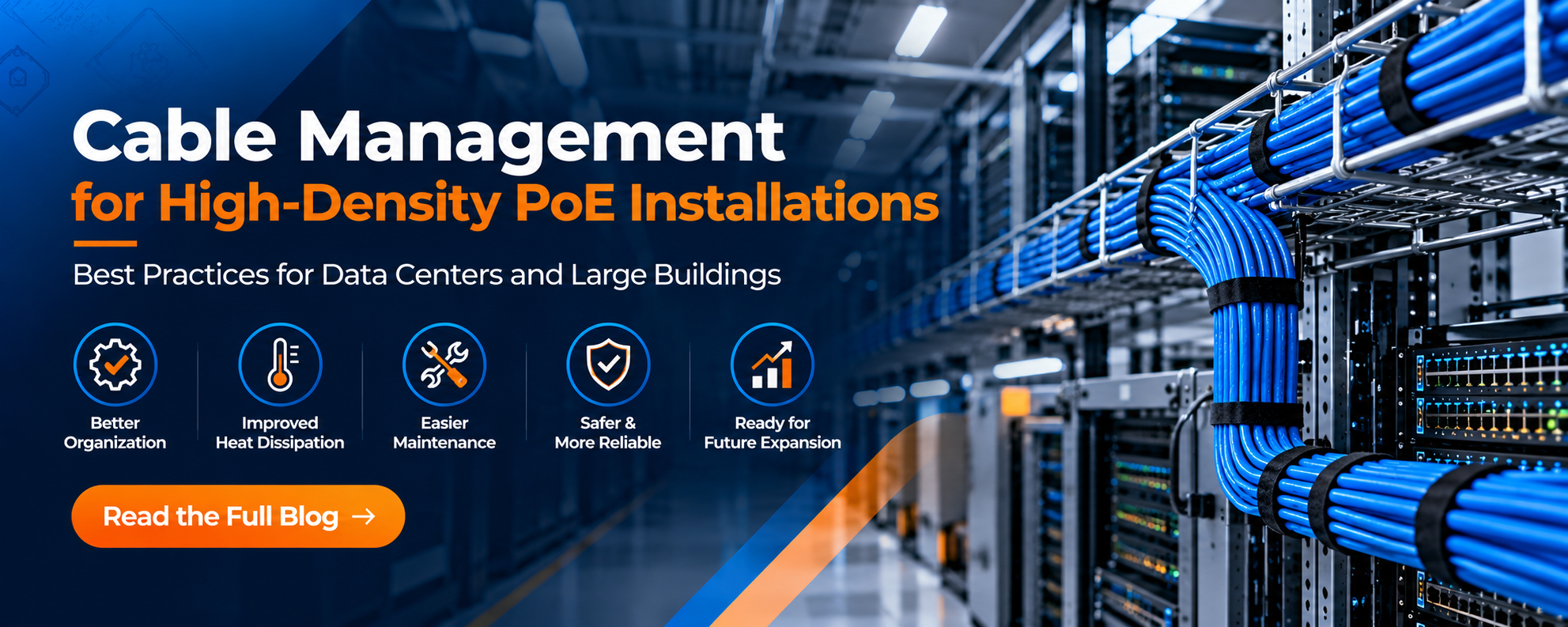
Cable Management in High-Density PoE Installations: Best Practices for Data Centers and Large Buildings
Power over Ethernet (PoE) has changed the way modern buildings connect and power network devices.
Instead of running separate cables for data and electrical power, PoE allows devices such as wireless access points, IP cameras, VoIP phones, sensors, and other connected systems to receive both through Ethernet cabling.
As PoE deployments become larger and more power-intensive, however, cable management becomes increasingly important. In data centers, commercial buildings, healthcare facilities, educational campuses, and other large environments, hundreds or even thousands of powered cables may run through the same pathways.
Without proper planning, these high-density installations can create challenges involving organization, heat dissipation, accessibility, and long-term maintenance.
Using the right Powered Cable Solutions can help infrastructure teams build networks that are easier to manage, safer to operate, and better prepared for future expansion.
Explore Now: remee.com/lan-premise-cables/activate-powered-cable-solutions/
Why Cable Management Matters in High-Density PoE Installations

Traditional network installations already require careful cable organization.
High-density PoE adds another consideration: the cables are carrying electrical power as well as data.
When large numbers of powered cables are grouped, the heat generated by the conductors can become more difficult to dissipate and can affect the integrity of the data signals.
This is particularly important when higher-power PoE applications are deployed across dense cable pathways.
Poor cable management can also make troubleshooting more difficult. A tangled or overcrowded pathway can slow down installation teams when they need to identify, replace, or test a particular cable.
For large-scale infrastructure, cable management should therefore be considered during the initial design phase rather than treated as an installation clean-up task.
Plan Cable Pathways Before Installation
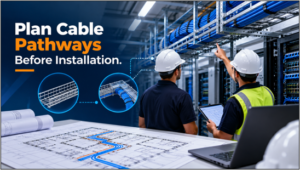
One of the most important steps in a high-density PoE installation is determining cable routes before pulling them.
Data centers and large buildings should have clearly defined pathways for horizontal and vertical cable runs.
Select cable trays, ladder racks, raceways, and other support systems based on expected cable volume and future expansion requirements.
Planning should consider:
- Current and future PoE device counts
- Cable bundle sizes
- Pathway capacity
- Bend radius requirements
- Access for maintenance
- Separation from potential sources of interference
- Future upgrades and additional connections
Avoid designing pathways that are just large enough for today’s installation. Leaving room for expansion can prevent major cable-management problems later.
Avoid Overcrowded Cable Bundles
Cable bundling makes an installation look organized, but excessive bundling can create problems in high-density PoE environments.
When many powered cables are tightly packed together, heat has fewer opportunities to escape.
As power levels and cable density increase, managing bundle size and spacing becomes increasingly important.
Installers should follow the applicable cable and equipment manufacturer’s recommendations for bundle size, spacing, and installation conditions.
Where appropriate, pathways should allow airflow around cable groups rather than compressing large numbers of cables into a single dense mass.
The objective is not simply to make cables look neat. It is to create a structured installation that supports reliable performance over time.
Use Proper Cable Support and Routing
Powered cables should be properly supported throughout their route. Excessive tension, sharp bends, compression, or unsupported cable weight can affect cable performance and make future maintenance more difficult.
Cable pathways should maintain appropriate bend radii and avoid unnecessary turns. Cables should also be routed in a way that minimizes strain at connection points.
In large installations, organized routing can make a significant difference when technicians need to trace a cable from a network cabinet to a device several floors or rooms away. Remee recommends using color-coded jackets or jacket striping to help identify cables.
Clear labeling at both ends of cables can further improve serviceability.
Think About Heat Dissipation
Heat management is one of the key considerations when deploying high-density PoE.
PoE and other power cables carry current through their conductors, and groups of powered cables can generate heat.
If cable bundles become too dense or are placed in environments with limited airflow, the temperature around the cables can increase.
Infrastructure designers should therefore consider the relationship between:
- Cable category and construction
- Power levels
- Bundle size
- Ambient temperature
- Installation method
- Airflow around cable pathways
Good cable management works together with the building’s overall thermal management strategy.
In data centers especially, cable pathways should be planned alongside rack layouts, cooling systems, and equipment placement.
Make Future Maintenance Easier
A network installation should not only work well on day one. It should remain manageable years later.
Large facilities frequently change. Devices are added, relocated, upgraded, or replaced, making MACs a regular activity. If cables are densely packed and poorly identified, every change can become a time-consuming project.
A well-organized system should allow technicians to:
- Trace individual cable runs
- Identify connections quickly
- Add new cables without disrupting existing ones
- Replace damaged cables efficiently
- Access equipment without disturbing nearby connections
Consistent labeling and documentation are especially valuable in large buildings where multiple network rooms and cable pathways may be involved.
Consider Powered Cable Solutions for Large-Scale Deployments
As PoE networks grow, conventional approaches to cable installation may not always provide the flexibility needed for complex enterprise environments.
This is where purpose-designed Powered Cable Solutions can become valuable.
Solutions such as Remee’s PowerPipe™ Cables – part of their Activate™ line of Powered Cable Solutions, are designed around the requirements of powered network infrastructure, helping address the practical challenges associated with delivering power and data across large installations.
For organizations planning extensive PoE deployments, selecting cable solutions that align with the project’s power, data, routing, and installation requirements can simplify infrastructure planning while supporting future scalability.
You can learn more about Remee’s powered cabling approach and PowerPipe™ solutions here: Remee Powered Cable Solutions
Design for Scalability
PoE technology continues to expand beyond traditional devices such as phones and access points.
Modern buildings increasingly rely on connected cameras, sensors, lighting systems, access-control devices, building automation equipment, and other networked technologies.
This means today’s cable infrastructure may need to support significantly more connected devices tomorrow.
A scalable cable-management strategy should therefore include spare pathway capacity, accessible routing, organized distribution points, and infrastructure capable of supporting changing power requirements.
Thinking ahead can reduce the cost and disruption associated with future network expansion.
Conclusion
High-density PoE installations require more than simply pulling large quantities of Ethernet cable
Effective cable management involves thoughtful pathway design, controlled bundle sizes, proper support, heat management, clear labeling, and consideration of future growth.
For data centers and large commercial buildings, these practices can make network infrastructure easier to maintain while helping support reliable long-term operation.
As PoE applications continue to expand, choosing appropriate Powered Cable Solutions is becoming an increasingly important part of network infrastructure planning.
By combining thoughtful cable management with purpose-designed cabling technologies such as PowerPipe™, organizations can build structured, scalable infrastructure ready for the growing demands of connected buildings.
Every high-density PoE installation has different power, routing, and scalability requirements.
The right cable solution can help you plan a more organized and reliable infrastructure from the start.
Looking for the right Powered Cable Solution for your project?
Ready to request your custom cable?
Connect with Remee’s cable experts to discuss your requirements, request information, or explore a customized solution.
Contact Remee today to get expert guidance for your next project.
Frequently Asked Questions
1. What is cable management in a high-density PoE installation?
It is the organized routing, support, and labeling of cables in high-density environments.
Proper management helps improve accessibility, airflow, safety, and network performance.
2. Why is heat management important for PoE cables?
PoE cables carry both data and electrical power, which can generate heat.
Proper spacing and cable management help maintain suitable operating temperatures.
3. How should PoE cables be organized?
PoE cables should be routed through suitable pathways and properly supported.
Avoid overcrowding, sharp bends, and excessive tension to maintain cable performance.
4. What are Powered Cable Solutions?
Powered Cable Solutions are designed to support network infrastructure that delivers both power and data. They can help simplify cabling for large and high-density PoE installations.
5. How can PoE infrastructure support future expansion?
Plan pathways with additional capacity for future cables, devices, and upgrades.
Good organization and scalable infrastructure can make future expansion easier and more efficient.