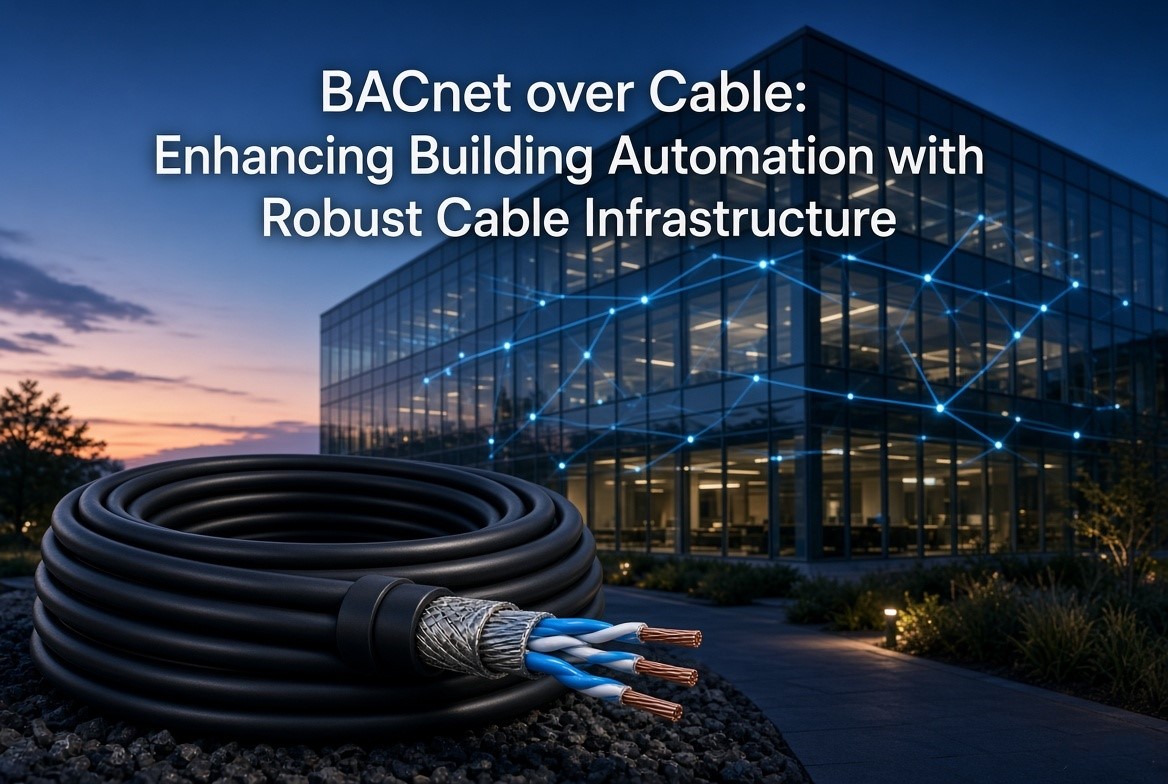
BACnet over Cable: Enhancing Building Automation with Robust Cable Infrastructure
A smart building is only as effective as the systems that keep it connected.
Today’s facilities are packed with connected systems from HVAC and lighting to access control, sensors, alarms, and energy management.
Behind these systems is a constant exchange of data, helping building operators monitor conditions, automate processes, and respond faster.
One technology helping make this possible is BACnet.
But while BACnet provides the language building systems use to communicate, another piece of the puzzle often gets less attention: the cable carrying the communication.
For BACnet networks, particularly BACnet MS/TP, the right cable infrastructure can be critical to maintaining reliable communication.
This is where purpose-built security cables and control cables can become an important part of a modern building’s communication infrastructure.
Choosing the right cable isn’t simply an installation detail; it can help support signal integrity, minimize interference, and create a more dependable foundation for connected building automation systems.
BACnet Is Helping Buildings Talk
BACnet, short for Building Automation and Control Network, was developed to allow different building automation devices and systems to communicate using a common protocol.
Instead of operating as isolated systems, compatible devices can exchange information across a building network, helping facility managers monitor conditions, automate processes, and manage building operations more efficiently.
Think about a modern commercial facility:
- A temperature sensor detects a change.
- The HVAC controller receives the information.
- The building management system processes it.
- The appropriate equipment responds.
All of this depends on one essential factor: reliable communication between connected devices.
BACnet supports a range of networking technologies, including Ethernet and BACnet MS/TP, a twisted-pair technology widely used for building control applications.
And that’s where the physical network becomes particularly important.
While BACnet provides the communication protocol, the cable infrastructure carries those signals between devices.
In environments where automation systems operate alongside access control, alarms, and other connected technologies, properly selected security cables can help provide the reliable physical foundation these systems need.
Because even the smartest building automation system is only as dependable as the infrastructure connecting it.
When the Network Gets Noisy, Cable Matters
Building automation systems don’t operate in a quiet laboratory environment.
They share space with motors, power cables, lighting equipment, variable frequency drives, electrical equipment, and countless other devices that can create electromagnetic interference.
For sensitive communication signals, that interference can become a serious concern.
BACnet MS/TP uses an EIA-485 physical layer, which means cable selection plays an important role in maintaining signal integrity. The BACnet specification calls for shielded twisted-pair cable with appropriate electrical characteristics, including suitable impedance and controlled capacitance.
This is where Security cables designed for communication and control applications can become an important part of the infrastructure.
The right cable construction can help protect sensitive signals from unwanted interference and support reliable data transmission across the network.
In simple terms:
The network needs a cable designed to optimally carry the signal—not simply a cable that happens to fit the installation requirement and might be the cheapest option.
When reliable communication matters, Security cables shouldn’t be an afterthought. They should be considered as part of the network design from the very beginning.
What Does BACnet Cabling Need?
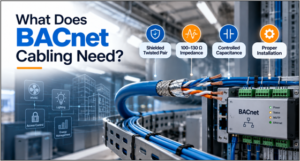
Choosing cable for a BACnet MS/TP network involves more than simply looking at conductor size.
The right Security cables need to match the network’s electrical and installation requirements to help maintain reliable communication.
Several characteristics matter.
Shielded Twisted Pair
Twisted conductors help maintain balanced signal transmission, while shielding helps protect communication from unwanted electrical interference.
For Security cables used around motors, power wiring, lighting equipment, and other sources of electrical noise, appropriate shielding can be particularly valuable.
Appropriate Impedance
BACnet MS/TP networks typically require cable with a characteristic impedance in the 100–130 ohm range.
Using cable with unsuitable characteristics can affect signal quality and network performance, particularly across longer cable runs.
Choosing Security cables with the appropriate electrical characteristics can help create a more dependable communication pathway.
Controlled Capacitance
Capacitance affects how signals travel through the network. BACnet specifies limits for distributed capacitance between conductors and between conductors and their shield(s).
For larger or faster networks, these electrical characteristics become even more important when selecting Security cables for the application.
Proper Installation
Even the right cable can perform poorly if the network is incorrectly installed.
BACnet MS/TP networks generally use a daisy-chain topology, with appropriate termination at the physical ends of the bus. Polarity, grounding, routing, and shield installation also need to be handled correctly.
The right Security cables + poor installation = poor network performance.
That’s why you should consider cable selection and installation together when building a reliable BACnet communication network.
Where Do Security Cables Come In?
Here’s where building automation and security infrastructure increasingly overlap.
Modern facilities don’t treat security systems as completely separate from building operations.
Access control, alarms, sensors, automation controllers, and building management systems can all become part of a larger connected environment.
That means security cables are no longer simply about connecting an alarm or access control device.
They can form part of the communication infrastructure supporting today’s interconnected facilities.
This is where choosing a cable designed for control and communication applications becomes important.
Introducing Vigilance™ by Remee
Remee’s Vigilance™ Security, Alarm & Control Cables are designed for the increasingly connected world of security, access control, automation, and control systems.
As building networks become more interconnected, reliable security cables play an important role in creating the physical infrastructure that supports device communication.
Vigilance™ by Remee includes shielded and unshielded cable constructions for different applications, with solutions designed around technologies such as BACnet, RS-485, Wiegand, and OSDP.
For applications where electrical interference is a concern, choosing appropriately designed security cables with shielding can provide additional protection for sensitive communication signals.
Remee’s foil-shielded cables are designed with 100% shield coverage to help protect signals from interference and signal degradation caused by unwanted electrical ingress or egress.
This is particularly relevant in modern facilities where communication cabling may share an infrastructure with motors, power wiring, lighting systems, and other electrical or electronic equipment.
With the right security cables, building automation and access control systems can have a more dependable physical foundation for reliable communication.
One Cable Can Do More Than You Think
Modern installations can involve more than just communication.
Depending on the application, installers may need to accommodate data, control, power, or other connections between equipment.
That’s where composite cable constructions can offer an advantage.
Vigilance™ includes access control composite cable solutions that can combine multiple cable elements into a single factory-manufactured assembly.
Instead of managing several separate cable runs, a composite or bundled construction can help simplify certain installations while keeping multiple functions together.
For contractors and system integrators, that can mean:
- Cleaner installations
- Simplified cable management
- Fewer individual cable runs
- Easier identification of connected systems
- A more organized infrastructure
The right configuration, of course, depends on the specific application and installation requirements.
Built for Real-World Building Environments
Building automation cable isn’t installed in a vacuum.
It may run through ceilings, risers, equipment rooms, mechanical spaces, or other challenging environments.
That’s why the cable’s construction and rating matter too.
Vigilance™ by Remee offers different cable constructions, including plenum- and riser-rated options, as well as specialized configurations for particular installation environments.
This gives installers greater flexibility when matching the cable to the building, application, and applicable code requirements.
The Smart Building Starts with the Infrastructure
It’s easy to focus on the visible side of building automation—the sensors, dashboards, controllers, and software.
But underneath all of it is an infrastructure that has to move information reliably.
BACnet gives building systems a common communication language.
The network design creates the pathway.
And the cable provides the physical connection that carries the signal.
When that infrastructure is properly designed, installed, and matched to the application, it can help create a more dependable foundation for building automation and connected security systems.
Because smarter buildings need more than smart technology
They need infrastructure that can keep up.
Cable selection should always be based on the applicable BACnet/RS-485 requirements, equipment manufacturer’s specifications, installation environment, and relevant local codes.
Looking for reliable cable solutions for modern building automation and security systems?
Explore Vigilance™ by Remee and find the right solution for your application.
Have questions or need help choosing the right cable solution? Connect with the Remee team today.
Ready to request your custom cable?
FAQs: BACnet Over Cable
-
What is BACnet?
BACnet (Building Automation and Control Network) is a communication protocol that allows building automation devices and systems to exchange information across a network.
-
What is BACnet MS/TP?
BACnet MS/TP is a twisted-pair networking technology commonly used for building control applications. It operates over an EIA-485 physical layer.
-
Why is cable selection important for BACnet MS/TP networks?
The cable carries communication signals between BACnet devices. A properly selected cable can help maintain signal integrity, reduce interference, and support reliable network communication.
-
What type of cable is recommended for BACnet MS/TP?
BACnet MS/TP typically requires shielded twisted-pair cable with suitable electrical characteristics, including appropriate impedance and controlled capacitance.
-
What impedance is required for BACnet MS/TP cabling?
BACnet MS/TP networks typically require cable with a characteristic impedance in the 100–130 ohm range.