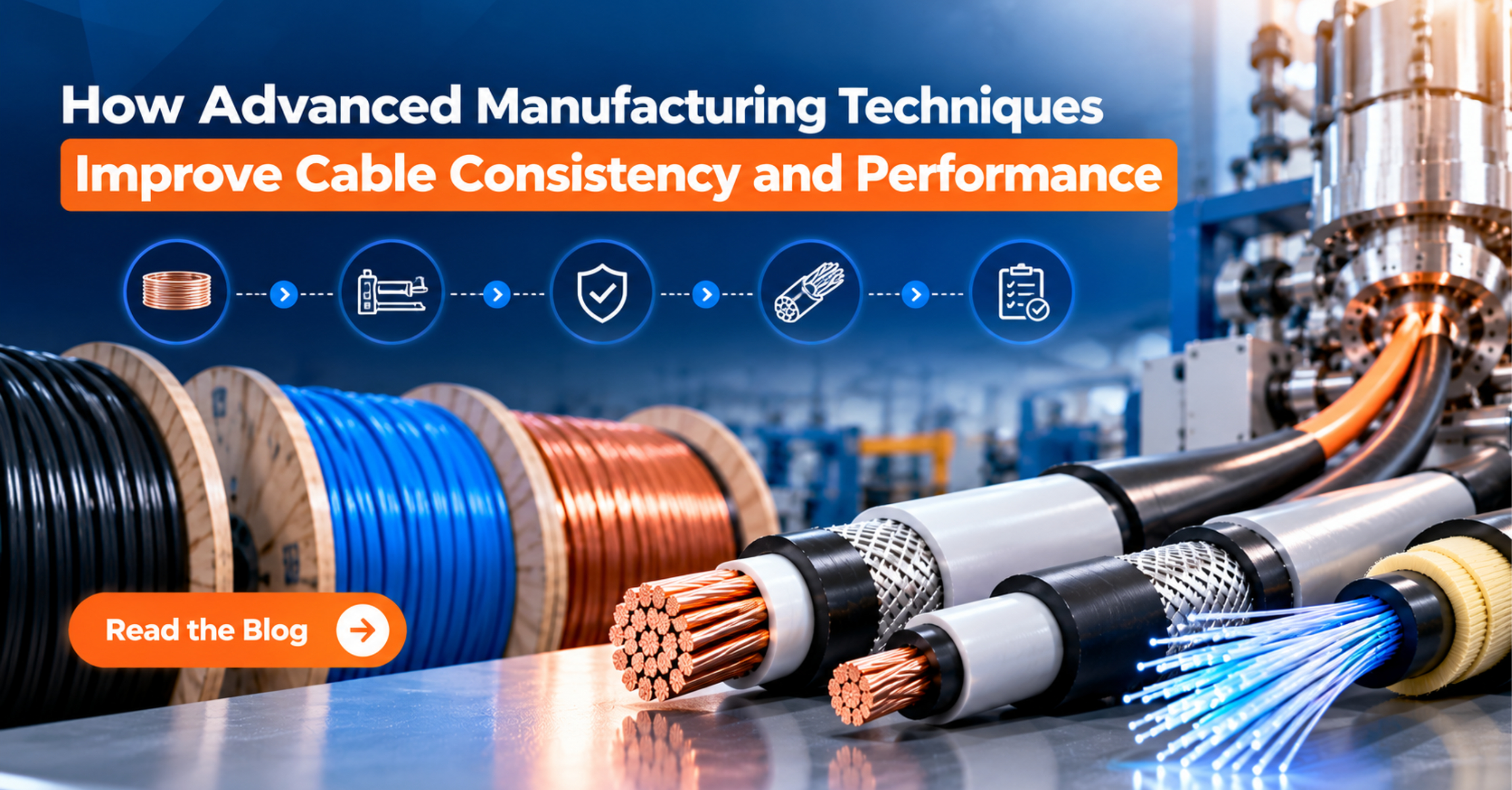
How Advanced Manufacturing Techniques Improve Cable Consistency and Performance
Have you ever wondered what makes one cable more reliable than another?
It’s not just about the materials. The real difference often comes down to how the cable is designed, manufactured, tested, and delivered.
Cables play an important role in our everyday lives, even when we don’t think about them.
They help power equipment, connect communication networks, transmit data, and keep industrial systems running smoothly.
Whether it’s a copper cable carrying electrical signals or a fiber optic cable transmitting data through light, consistent quality is essential for dependable performance.
But achieving that consistency isn’t always simple. Small variations in conductor size, insulation thickness, cable construction, or material quality can affect how a cable performs over time.
That’s where advanced manufacturing techniques make a difference.
From copper drawing and insulation extrusion to shielding, fiber optic cable assembly, and final testing, every stage contributes to the quality of the finished product.
At Remee Wire & Cable, engineering expertise and manufacturing capabilities help create cable solutions designed to meet different application requirements.
Let’s look at how these manufacturing techniques work and why they matter.
It All Starts with Good Engineering
Before a cable reaches the production line, someone needs to figure out exactly how it should work.
- Where will the cable be used?
• Will it operate indoors or outdoors?
• Will it carry electrical signals, transmit optical data, or do both?
• Does it need to withstand high temperatures, moisture, or mechanical stress?
These questions help engineers determine the right materials, dimensions, and construction.
For example, a cable used in an industrial facility may need stronger protection against physical damage and electrical interference.
A fiber optic cable used in a communication network needs a construction that protects its optical fibers while maintaining reliable light transmission.
Getting these details right from the beginning can prevent problems later.
Remee’s engineering capabilities include developing new cable designs, modifying existing constructions, and creating specialized solutions for customer requirements.
This flexibility helps match cable performance to the needs of the application.
Copper Drawing: Getting the Conductor Just Right
Copper is widely used in electrical and communication cables because of its excellent electrical conductivity.
However, using good-quality copper is only part of the equation. The conductor must also have the right dimensions and a consistent structure.
This is where copper drawing comes in.
During this process, copper is pulled through specially designed dies to reduce its diameter to the required size. The process needs to be carefully controlled to maintain consistent dimensions and a suitable surface finish.
Why does this matter?
Imagine a cable with conductors that vary significantly in size. These variations can affect electrical resistance and make it harder to maintain consistent performance across the finished product.
A well-controlled drawing process helps manufacturers produce conductors that meet the required specifications.
It also provides a reliable foundation for the next stages of production, including insulation, shielding, and cable assembly.
Of course, copper drawing applies to copper conductors rather than the glass fibers inside a fiber optic cable. But the principle is the same across both types of manufacturing: controlling important details helps create a more consistent final product.
Insulation and Jacketing: Protecting What’s Inside
A cable may contain high-quality conductors or optical fibers, but how well are those components protected?
Insulation and outer jackets play a major role in answering that question.
During extrusion, materials are processed and shaped around a conductor or cable core to create a protective layer. When the process is properly controlled, the insulation and jacket maintain the required thickness and dimensions.
This consistency matters for several reasons.
In copper cables, insulation helps prevent unwanted electrical contact and supports safe, reliable operation.
The outer jacket can provide additional protection against abrasion, moisture, chemicals, and temperature changes, depending on the material selected.
For a fiber optic cable, protective layers help shield delicate optical fibers from physical damage and mechanical stress.
Material choice is equally important. Different applications may require different levels of flexibility, temperature resistance, flame performance, or environmental protection.
Remee works with a range of insulation and jacket materials to support different cable constructions and application needs.
By combining suitable materials with controlled extrusion processes, manufacturers can produce cables that offer consistent protection and dependable performance.
Shielding and Braiding: Keeping Signals Reliable
Electrical interference can be a real challenge, especially in environments filled with motors, industrial equipment, and electronic devices.
In certain copper cable applications, electromagnetic interference can affect signal quality. Shielding and braiding help reduce the impact of this interference when properly designed and installed.
Shielding typically involves placing a conductive layer, such as metallic foil or braided metal, around the cable’s internal components.
Braiding uses interwoven conductive strands to create a protective layer. Depending on the design, it can also contribute to mechanical protection and flexibility.
However, simply adding a shield isn’t enough. Its coverage, placement, and construction must meet the cable’s requirements.
Consistent manufacturing helps ensure that shielding layers are applied correctly and that the finished cable delivers the intended performance.
Fiber optic cables have an advantage here: optical fibers transmit information through light and are not affected by electromagnetic interference in the same way as copper conductors.
However, some applications use hybrid cables that combine copper conductors and optical fibers under one jacket. In these cases, the copper components may still need appropriate shielding.
This is one example of how different manufacturing techniques can work together to support more complex cable solutions.
Cable Assembly: Why Every Component Must Fit Together
Once the individual components are ready, they need to be assembled into the final cable structure.
This stage is more important than it might seem.
The way conductors, insulation, optical fibers, fillers, and protective elements are arranged can affect the cable’s flexibility, dimensions, strength, and overall performance.
In communication cables, for example, the arrangement and twisting of conductor pairs can help manage interference and crosstalk.
In a Fiber Optic Cable, the positioning of fibers, protective tubes, and strength members helps determine how the cable responds to bending, pulling, and other mechanical stresses.
Too much tension during production or an unsuitable internal arrangement can increase the risk of damage or affect performance.
That’s why manufacturers pay close attention to component alignment, production tension, cable geometry, and assembly consistency.
Remee’s cabling capabilities support a variety of cable constructions, from straightforward designs to more complex configurations.
When all the components are assembled correctly, the result is a cable designed to perform reliably under its intended operating conditions.
Fiber Optic Cable Manufacturing: Protecting Performance from the Inside Out
As data demands continue to grow, fiber optic technology has become increasingly important for telecommunications, data centers, broadband networks, and industrial communication systems.
Unlike copper cables, which carry electrical signals, a fiber optic cable transmits information using light through optical fibers.
This allows fiber optic technology to support high-bandwidth communication over long distances. However, the optical fibers themselves require careful handling and protection.
So, what makes fiber optic cable manufacturing different?
H3: Protecting delicate fibers
Optical fibers can be affected by excessive bending, pulling, or physical damage. Depending on the design, manufacturers use protective buffers, tubes, strength members, and outer jackets to help protect them.
H3: Choosing the right construction
Not every installation requires the same cable design. Loose-tube cables, tight-buffered cables, and different indoor or outdoor constructions each offer characteristics suited to particular applications.
H3: Maintaining optical performance
The cable must protect the fibers without introducing excessive optical loss. Depending on the product specification, testing may include measurements of attenuation and other relevant optical characteristics.
H3: Meeting application requirements
Some installations need additional environmental protection, specific jacket materials, or specialized mechanical properties.
Choosing the right construction helps ensure that the cable is suitable for its intended environment.
Remee offers a range of fiber optic cable options, including single-mode and multimode designs, loose-tube and tight-buffered constructions, and indoor and outdoor cable solutions.
By combining appropriate materials, careful assembly, and application-focused engineering, manufacturers can help maintain the optical and mechanical performance needed for dependable communication networks.
Quality Testing: Checking Before the Cable Leaves the Factory
Even with carefully controlled manufacturing processes, quality checks remain essential.
After all, how can manufacturers be confident that a cable meets its specifications without inspecting and testing it?
Quality control can take place at several stages of production. The specific tests depend on the cable’s construction, intended application, and relevant standards.
For copper cables, testing may include electrical continuity, conductor resistance, insulation integrity, and other specified electrical properties.
For a Fiber Optic Cable, testing may focus on optical attenuation and other performance characteristics relevant to the design.
Mechanical tests can also be important. Depending on the product, manufacturers may evaluate tensile strength, crush resistance, flexibility, or performance under temperature variations.
These checks help identify potential problems before products reach customers.
Consistent quality procedures also make it easier to detect manufacturing variations and investigate issues when they arise.
The goal isn’t simply to pass a test. It’s to ensure that the cable meets the requirements for which it was designed.
Packaging and Shipping: Quality Doesn’t End at Manufacturing
Once a cable passes its required checks, is the job finished?
Not quite.
Even a well-manufactured cable can be damaged if it isn’t handled, packaged, or transported properly.
Cable reels and packaging need to suit the product’s dimensions, weight, construction, and delivery requirements.
Suitable handling practices help prevent unnecessary bending, crushing, abrasion, and other forms of damage.
This is particularly important for fiber optic cable products, where excessive bending or physical stress can affect optical performance.
Accurate labeling and careful order preparation also help customers receive the correct cable type, length, and specifications.
Remee’s manufacturing capabilities extend to packaging and shipping, supporting the process from production through delivery.
Paying attention to these final steps helps ensure that cable quality is maintained beyond the factory floor.
Custom Cable Solutions for Different Applications
Sometimes, a standard cable simply isn’t the right fit.
An industrial system may need additional mechanical protection. A communication network may require a particular fiber configuration. Another application may need electrical conductors and optical fibers within the same cable assembly.
These situations call for custom engineering.
By adjusting materials, dimensions, shielding, strength members, or internal arrangements, manufacturers can develop cable constructions suited to specific operating requirements.
Hybrid cables are a useful example. They combine copper conductors and optical fibers in one cable, allowing a single construction to support both electrical and optical functions.
However, bringing these components together requires careful planning. The design must account for the electrical requirements of the copper elements and the optical and mechanical requirements of the fibers.
Remee supports custom and complex cable constructions, helping customers explore solutions for specialized applications.
With the right engineering approach, custom cable designs can address specific challenges without sacrificing consistent manufacturing quality.
Conclusion
Reliable cable performance doesn’t happen by accident. It comes from getting the details right at every stage of manufacturing.
From precise copper drawing and uniform insulation to effective shielding, careful cable assembly, and thorough quality testing, each process contributes to the consistency and durability of the finished product.
The same is true for a fiber optic cable, where protecting delicate optical fibers and maintaining optical performance are essential for dependable data transmission.
And the process doesn’t stop when manufacturing ends. Proper packaging, handling, and shipping help ensure that cables reach customers in the condition they need to be in.
Remee Wire & Cable brings engineering expertise and a broad range of manufacturing capabilities together to support standard, modified, and custom cable solutions for different applications.
When choosing a cable manufacturer, it’s worth looking beyond the finished product and understanding how it is made. Because in the long run, consistent manufacturing is one of the foundations of reliable cable performance.
Want to learn more about Remee’s manufacturing capabilities? Explore the engineering and manufacturing process here: https://remee.com/engineering-manufacturing-at-remee/
Frequently Asked Questions (FAQs)
1. How do advanced manufacturing techniques improve cable quality?
Advanced manufacturing techniques help maintain consistent conductor dimensions, insulation thickness, shielding, and cable construction. These processes reduce variations, help prevent defects, and support reliable cable performance over time.
2. Why is manufacturing precision important for Fiber Optic Cable?
Manufacturing precision is important for fiber optic cable because optical fibers are sensitive to excessive bending, tension, and physical damage. Careful assembly, suitable protective materials, and appropriate testing help maintain optical performance and long-term reliability.
3. What are the key stages of cable manufacturing?
The main stages include engineering and design, conductor preparation, insulation and jacket extrusion, shielding, cable assembly, quality testing, packaging, and shipping. The exact process depends on the cable type and its intended application.
4. How do manufacturers ensure consistent cable performance?
Manufacturers use controlled production processes, material inspections, dimensional checks, and electrical, optical, or mechanical testing as required. These quality control measures help verify that cables meet their specified performance requirements.
5. Can cable manufacturers develop custom Fiber Optic Cable solutions?
Yes. Depending on their capabilities, manufacturers can develop custom fiber optic cable solutions with specific fiber types, cable constructions, protective jackets, and mechanical properties. Some designs can also combine optical fibers and copper conductors to meet specialized application requirements.