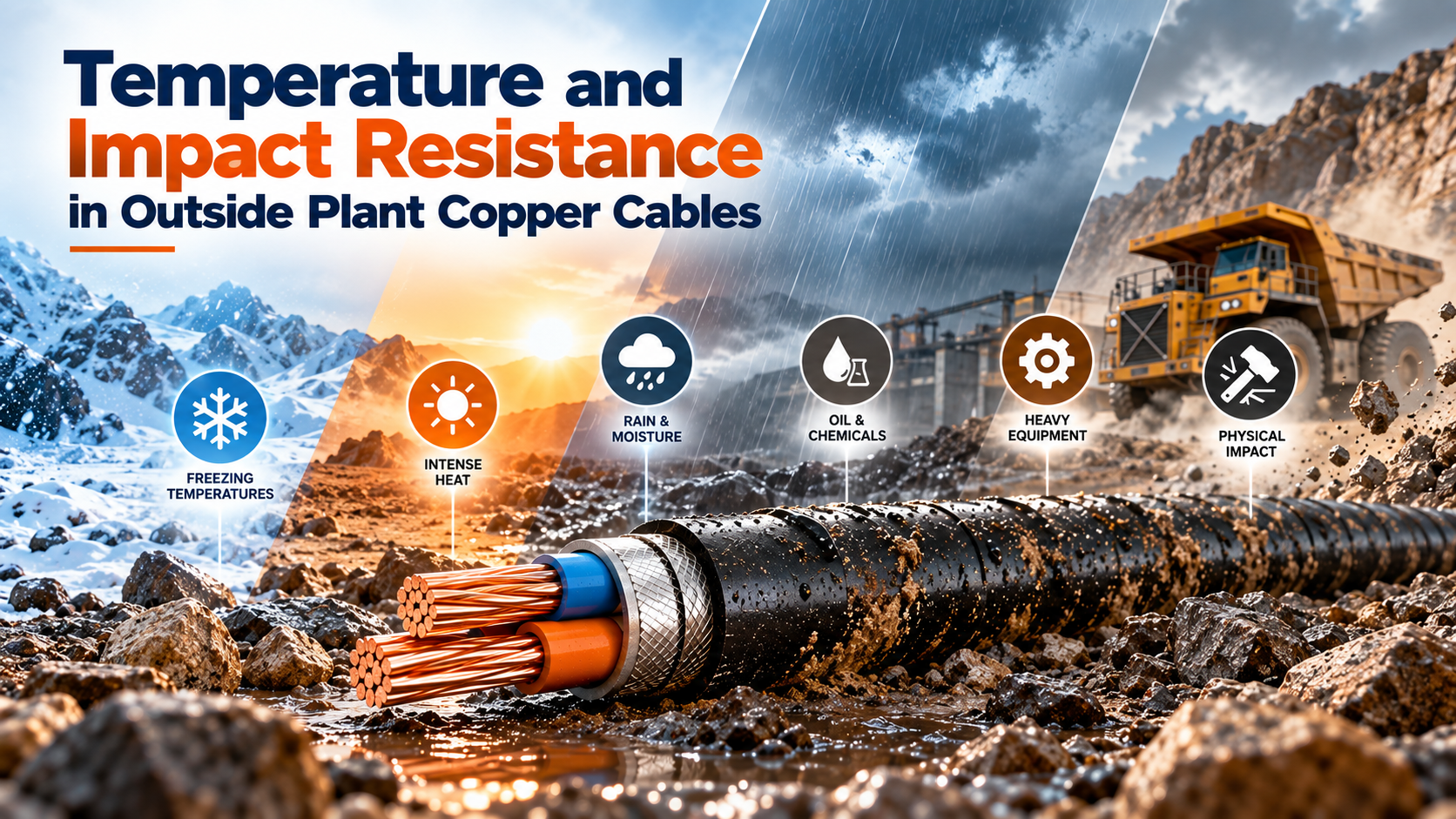
Temperature and Impact Resistance in Outside Plant Copper Cables
When copper cables are installed indoors, they are largely protected from the elements. An outside plant infrastructure doesn’t have that luxury.
Cables installed across mining sites, utility networks, industrial facilities, and other outdoor environments can face freezing temperatures, intense heat, moisture, chemicals, UV exposure, heavy equipment, and physical impact, all while being expected to maintain reliable signal transmission.
That makes one thing clear: Outside plant copper cables need to be built for the environment, not just the application.
Remee’s range of rugged wet-location, OSP, and buried cables is designed for demanding outdoor conditions where durability, flexibility, and signal integrity are critical.
Why the Outside Environment Matters
An outside plant cable can experience dramatic changes in conditions throughout its service life.
A cable installed in a mining operation, for example, may be exposed to:
- Freezing winter temperatures
- High ambient temperatures
- Direct sunlight and UV exposure
- Rain and moisture
- Oil and chemicals
- Heavy machinery and equipment
- Physical impact and abrasion
- Repeated environmental changes
These conditions don’t just challenge the cable’s outer jacket. Over time, environmental stress can affect the cable’s physical integrity and its ability to maintain dependable electrical performance.
For communication infrastructure, that can translate into something operators cannot afford:
Signal problems, maintenance, and downtime.
This is why selecting the right Copper Cables for an outside plant application requires looking beyond basic conductivity.
Built to Handle Temperature Extremes
Temperature is one of the biggest environmental considerations when deploying outdoor cabling.
In cold climates, cable materials need to withstand low temperatures without becoming excessively rigid or vulnerable to damage.
At the other extreme, high ambient temperatures can place additional stress on jackets, insulation, and other cable components.
In addition, prolonged exposure to UV rays can break down some cable jacketing, causing signal issues.
Outside plant cables may also experience significant temperature cycling, moving repeatedly between cold nights, hot days, seasonal changes, and equipment-generated heat.
Remee’s wet-location and outside plant cable solutions are designed to withstand extreme temperature variations, along with other outdoor environmental conditions such as moisture and direct sunlight.
For infrastructure operators, this environmental durability helps support the long-term performance expected from critical Copper Cables.
What Happens When Cables Face Heavy Impact?
Temperature isn’t the only challenge.
In mining and utility environments, cables may be installed near heavy machinery, construction equipment, vehicles, and other sources of physical abrasion and stress.
A cable can be exposed to accidental impact during installation, maintenance, excavation, or day-to-day site operations.
Underground and direct-burial installations introduce additional considerations because the cable may encounter mechanical forces from surrounding soil, equipment, or future excavation work, and even rodent activity.
This is why outside plant cables need more than electrical performance.
They need physical resilience.
Remee notes that its wet-location, OSP, and buried cables are designed to withstand impact while remaining flexible and maintaining signal integrity.
Protecting Signal Integrity in Harsh Environments
A cable’s job doesn’t stop at surviving the environment.
It also needs to continue carrying signals reliably.
Moisture ingress, electrical interference, temperature changes, and physical damage can all create challenges for outdoor communication infrastructure. Cable construction therefore plays an important role in helping protect the signal pathway.
Remee’s outside plant cable portfolio includes features such as:
- Water-blocking technology
- Shielding options
- Sunlight-resistant jackets
- Direct-burial constructions
- Metallic or all-dielectric messengers
- Copper and fiber optic configurations
- Bundling, hybrid and composite cables
- Armoring options
These options allow cable construction to be matched more closely to the demands of a particular installation.
Water Protection Matters Too
Temperature and impact may be the focus, but outdoor infrastructure rarely has to deal with just one environmental threat.
Moisture is another major concern.
Rain, groundwater, condensation, and wet soil can expose cables to moisture over extended periods. For buried and outside plant installations, protecting against water ingress can therefore be an important part of maintaining cable performance.
Remee offers OSP and direct-burial Copper Cables featuring water-blocking technology designed for applications where moisture protection is required.
This becomes particularly relevant for infrastructure installed underground or in wet and unprotected environments.
Mining: Where Cable Durability Gets Put to the Test
Mining environments are among the more demanding locations for cable infrastructure.
Cables can encounter machinery, vibration, moisture, chemicals, temperature fluctuations, and physical hazards while supporting communications and other critical systems.
Remee identifies mining as one of the applications for its wet-location cable solutions, alongside direct burial, telecommunications, and fiber optic applications.
Some Remee copper and fiber cable designs also have MSHA certifications available, depending on the specific construction.
For mining operators, choosing appropriately constructed Copper Cables can help address the combination of environmental and mechanical demands found in these applications.
Utility Infrastructure Needs the Same Resilience
Utility networks face many of the same challenges.
Communication and control infrastructure may extend across large outdoor areas, where cables can be exposed to sunlight, rain, temperature changes, moisture, and physical disturbances.
Replacing damaged infrastructure isn’t always straightforward.
A cable may be buried underground, routed through difficult terrain, or installed in an area that is costly or disruptive to access.
That makes durability an important consideration from the beginning.
The goal isn’t simply to install a cable that works today.
It’s to build infrastructure capable of continuing to perform in the environment where it is installed.
Choosing the Right Copper Cable for the Application
There is no single cable construction that fits every outside plant environment and application.
The right choice depends on factors such as:
- Temperature: What are the expected minimum and maximum operating conditions?
- Moisture: Will the cable be exposed to rain, groundwater, wet soil, or other sources of moisture?
- Installation: Is it being installed overhead, underground, in conduit, or through direct burial?
- Physical stress: Could the cable encounter heavy equipment, impact, crushing, or abrasion? Rodent activity? Remee also offers armoring as an option.
- Sunlight: Will the cable be continuously exposed to UV radiation?
- Interference: Does the environment contain electrical equipment that may create signal interference?
- Support: Does the installation require a metallic or all-dielectric messenger?
Considering these factors helps ensure the selected Copper Cables are suited to the actual conditions they will face.
Remee: Copper Cables Built for Demanding Environments
Remee offers a broad range of rugged wet-location, outside plant, and buried cable solutions designed for demanding outdoor applications.
Its portfolio includes copper and fiber optic options, shielded constructions, water-blocking technology, sunlight-resistant jackets, messenger-supported designs, and armoring options. Remee also offers modified and custom wet-location cable configurations to meet specific project requirements.
The company manufactures its wet-location cables in the United States under ISO 9001 certification, with MSHA certifications available on certain copper and fiber designs.
For projects where standard cable offerings don’t meet the environmental or installation requirements, Remee can also modify existing designs or develop custom solutions.
Built for the Conditions That Matter
An outside plant infrastructure doesn’t get to choose its environment.
It has to perform through freezing winters, high temperatures, moisture, sunlight, machinery, and physical stress.
That’s why Copper Cables for mining, utilities, and other outdoor infrastructure need to be selected with both signal performance and physical durability in mind.
The right cable can provide more than a connection. It can provide a resilient foundation for communication infrastructure where access, maintenance, and reliability matter.
When the environment is tough, your cable infrastructure needs to be tougher.
Explore Remee’s Outside Plant & Mining Copper Cables to find cable solutions designed for demanding outdoor applications.
Explore Remee Outside Plant & Mining Copper Cables
Cable selection should always be based on the specific installation environment, applicable standards, project requirements, and manufacturer specifications.